Friday, August 12, 2011

Everest Calling - Phakding To Namche


18th April 2011.

Few things in life could be more painful than waking up at 6:30 AM on a cold Himalayan morning. That is also the time and place when hot water becomes worth its weight in gold. And that is the time and place when every soul thinks of the Sahara desert with a wistful yearning. That cold Himalayan morning is a very powerful context.

Breakfast in Phakding was two slices of bread with boiled potato sauté with turmeric, salt and some green leaves. Honey and mixed fruit jam were available too. Everywhere we went, throughout the tour, honey and a variety of jams and marmalades were available.


We were set to start our march to our next destination – Namche Bazaar – the distance we had to cover was one among the longest distances we would cover in a day during the trek.

I bought a contour map for Rs 200 INR from the counter, hoping to refer to it as I trekked to figure out the names of rivers and peaks that appeared by our trail. I did not make any use of it.

The first things we saw when we stepped out.


It was sunny fortunately. For photography.


Our trail was by the Dudhkoshi river.


I think this is the Taboche peak considered holy. So people don’t climb the mountain. They believe if you climb it, villages at the foothills and surroundings face trouble – natural calamities and all...


Cherry blossom, we were told...


An old porter carrying his karma…


This was the entrance to the Sagarmatha national park. Mt. Everest is called Sagarmatha in the locality.


The ornamentation at the entrance.


Every hanging bridge was a thrill.


A picture taken from the shaking trembling bridge. Even one person walking on it at the far end would set it bouncing up and down.


We stopped for lunch in a place called Jorsalle.

Swami’s pedometer recorded 13.5 kilometers from the first hanging bridge after Phakding to Jorsalle – must be inaccurate – for we covered it between 7:15 AM to 10:30 AM.
We were 29 of us and we realized soon that we were not to trek together as one group. Some walked fast, some slow, some needed rest, some didn’t, some stopped too many times for photos, some didn’t. so we walked in smaller groups and sometimes alone.

When I reached Jorsalle, some of them had already reached. They cheered and clapped for me. We all cheered and clapped for everyone who arrived and this continued throughout the expedition.
We had lunch in two batches and after a few minutes of rest started again.


At one point we came really close to the Dudhkoshi river that tempted us to jump.


Porters resting. Boys from 17 to 21.


Announcing their arrival with clinging bells, horses came in a procession. Trekkers quickly moved to the mountain side of the trail and waited patiently. I needed some practice since I have this instinct to move to the valley side of the trail.


As we climbed, the valley below became more beautiful. Distance hid from view reeds and weeds and thorny dry shrubs, jagged cliffs and precipices became smooth, green remained while the browns and grays retreated, the roar of the river turned into a distant drone and silence descended from the skies.


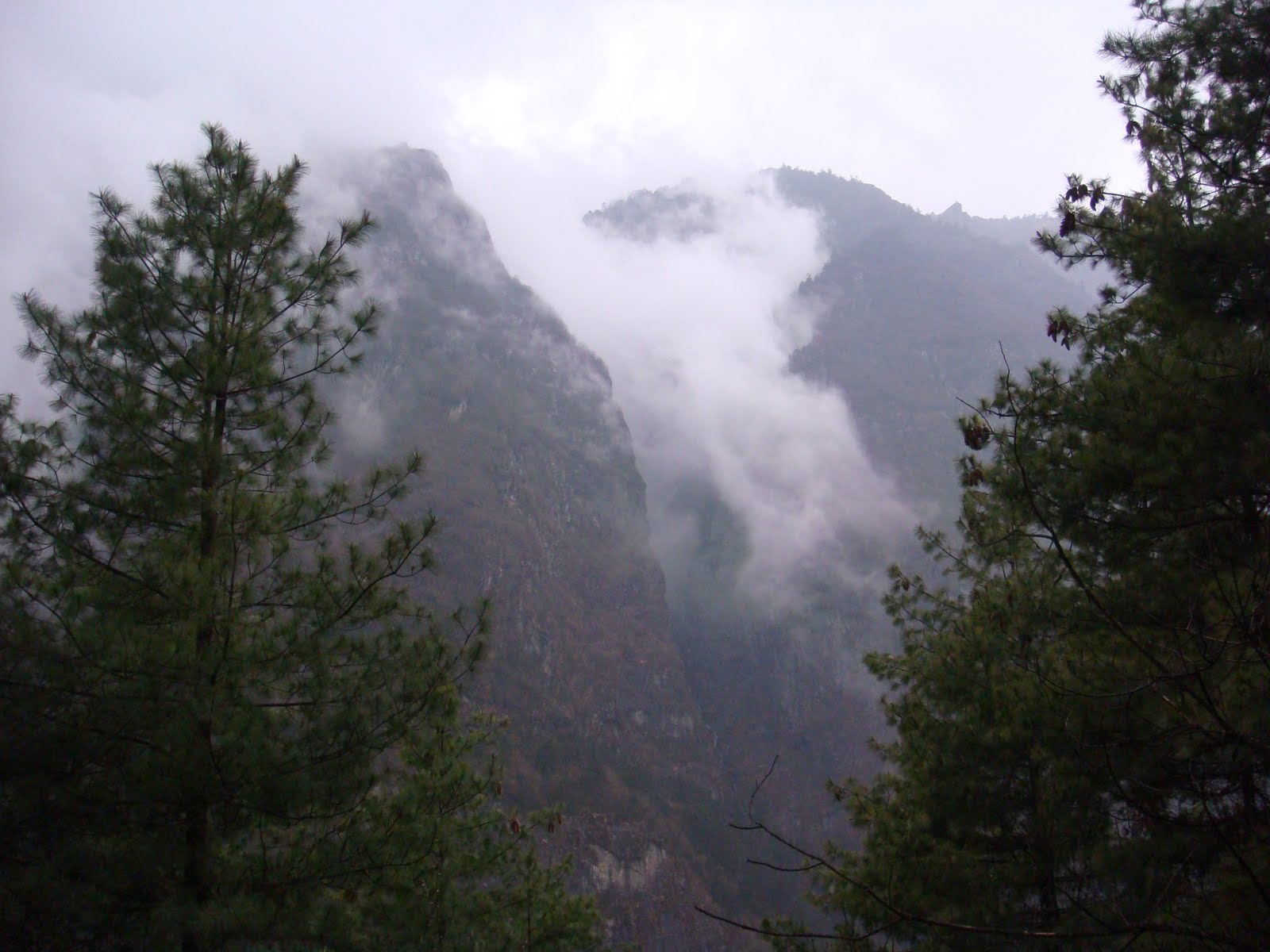
It was getting cloudy.


Porters and trekkers on the trail who had earphones on and were listening to music, would you not listen to the music of the mountain and to it’s silence instead of film music?


Breadth, depth and height. That picture is the most special of all.


It started raining. Then it started raining hails. My jacket was in the baggage that the porter had carried away. I put on my hat. I remembered I had forgotten to pack my umbrella.
I got a little wet but did not care.
Arnab removed two small plastic covers containing what looked like handkerchiefs of silver. We started opening it. Fold after fold, fold after fold we unfolded it until it was the size of a blanket. I believe it protected 90% of body heat. I wrapped it around myself, all excited. It crackled like thin metal every time I moved an inch but it was cool!

Arnab put on his space suit, I mean his rain suit and minutes later, it stopped raining. Just when I smiled thinking that Murphy’s laws work at high altitudes too, it started raining again and that redeemed his effort.

When it stopped raining I had to remove the silver wrap around me and fold it. With help from a French guy who was passing by me, I folded it and no matter how much I tried, I could not reduce it to the size of a handkerchief.

All of them were pine trees. How I wish they were Devdar. How much fragrance they would have effused into the air! I thought of my stay in Gangothri, in the Indian Himalayas. It was surrounded by gardens and forests of Devdar and the whole place smelled of incense. If heaven had a smell, it had to be the smell of Devdar. I and Ranjana had woken up in the morning to the smell that had become suddenly strong. We stepped out of the room to find out that they were burning twigs of Devdar wood to het water for us!

For now, I had to be content with the scent of rain-kissed earth.

Drops of water at the end of every pine needle. Little bulbs.


After it rained the fog cleared, revealing to us three snow covered peaks rising from the tops of pine trees. A closer look revealed the colour of snow to be fluorescent blue at the tip of these peaks.


Namche. We expected it to be around the next corner and it turned out to be elusive.
But when we saw terraces with dwellings in their middle, we knew it would be anytime soon.


Trust me, this is how these peaks really looked. Like jewels. I do not believe in editing my pictures.
Sunlight, clear, sharp and unobstructed by clouds in a clear afternoon sky after rain was on these peaks and the snow reflected the light.


When we finally arrived, what met our eyes seemed worth the effort. Neat dwellings on terraces that gave you a view of the whole village and hid nothing, wayside shops selling colourful jewelry, trinket, shawls, sweaters, hats, bakery, pubs, Buddhist assortments… it was really a titanic amphitheatre embellished with life itself.


We walked in narrow busy lanes, wet and dry, and finally reached Himalayan Hotel.


Thursday, August 04, 2011

The Moving Finger Writes


One of the admirable qualities I possessed (among others : )) in childhood, was a beautiful handwriting.

I remember once, during my visit to my mom’s sister’s place, a village in Hassan district, I had filled two foolscap sheets with the names of all my cousins, aunts, uncles on both father’s and mother’s side in Kannada. I must have been seven years old then.
I did not have anything else to write, but I knew I had to fill the sheets with closely written words for the writing to look beautiful.
If you know the Kannada language, its script - rounded, loopy, curvy, swirly - like ‘Jalebi’ as the North Indians in Bangalore describe it, you can imagine how it must have looked.
When I was in Gujarat, in Ahmedabad, my classmates had asked me to write my name in Kannada and when I had finished, they had commented ‘Oye…this looks like some Mehendi design’.

While filling in those foolscap sheets, I had taken care not to make a single mistake, not to strike out a single word, and thus avoided all ugliness and then shown it to my aunt after finishing. She had gasped, said my writing was so beautiful, that too, for someone my age, and passed it around.
Everyone took it in their hands, looked at it and nodded their head in approval.

Coming to think about it now, that must have been the first thing I wrote, if you exclude my school homework.
I must say I have come a long way :-)

My brother’s writing was always bad. It was incredibly bad – my father called it kolikal – cock’s feet. The new proper spelling would be ‘kozhikaal’.
It was so illegible. We hoped it would improve with time. But it remained the same throughout. I don’t have the right adjective.
It looked like a scattering of disfigured alphabets.
His marks in class exams remained poor – even when he had done well – because the examiners could not understand what he had written and I guess they were offended or angered that they had to go through pages of that annoying script wondering if they were holding the answer sheets upside down and if they should rotate it by 90 or 180 degrees.

My mother, after lamenting his writing, her face contorted and all, would invariably change her expression in the same breath to remark about my beautiful writing to my father.
My father would purse his lips and remark that people with beautiful handwriting did not lead very happy lives.
I don’t know where he picked that up from!
I don’t know if my father was right but today, as I look at my brother, I feel he is happier than me. People who simply live their life are usually happier than those who think about life. Isn’t it?

Though my own writing was good, I was more than once, tempted to imitate the writing of some people whose handwriting impressed me very much.
The first one, as I remember, was a girl called Kira, my classmate in 7th standard when I was in Ahmedabad, and my best friend for a while. Her letters were disjointed. Medium sized letters, neither long and narrow nor short and broad.
Neat.
It was probably closest to the Calibri font. I did adopt that writing. But I can’t remember when I discarded it and returned to my own.

The next time was quite recent. When I was studying B.Sc. in Teresian college, Mysore. I had a classmate called Alby Meera Thomas from Kerala. Her writing, I will compare not to a font, but to a beautiful aristocratic lady.
Tall, slim, continuous and flowing gracefully. The loops were the best part. Not too generous. Not really rounded. Sharp at the inner end and slightly drawn out at the outer.
Whenever the college or the class needed posters to be put on notice boards, it was her calligraphic writing that adorned those posters.

Although it was the same hand doing the writing, I now realize with wonder that the result varied from pen to pen.
Certain pens, mostly ball point, caused my writing to be less beautiful. The realization would result in effort on my part to restore beauty in the writing, but after a while, the pen asserted its right to leave its mark.
And then there were pens that seemed to possess a strange capacity to make any writing beautiful. It was like magic. You pushed it across a paper effortlessly and the result was beautiful. Always.

That’s when certain pens came to be preferred to others.
The hero pen.
Into which you had to fill ink using an ink filler. The older the pen, the smoother the writing and lesser the friction.
I had just one and how I coveted a few beautiful hero pens when I saw them in a stationery shop!

And then there was the pilot pen – with micro-tip - and another cheaper kind that looked like the pilot pen but had a fibre tip that spent itself with time, became smaller and smaller and had to be replaced. I used to covet these pens too.

What I coveted as a child but never possessed was the double-decker pencil box. I don’t know if that’s what it was called or I had given it that name.
We had moved to Gujarat from the South since my father had been transferred. And suddenly we were surrounded by these rich kids possessing all sorts of fancy accessories in school.
They had more clothes than us and also more beautiful ones.
They ate fancy looking and sounding stuff that made our Idli and Dosa and curd rice seem so plain.

This double-decker pencil box was a box that could be opened on both sides. Top as well as bottom. And on each side, there were two compartments alongside – one long for pencils, pens etc. and another small for rubber and sharpener. All the lids had magnets inside to close them. Opening the lids required a gentle push upward. The box was finished with glossy colourful designs – pink, red,…and looked beautiful.
For many days – I think as long as I was in Gujarat, I dreamed that I would possess it one day. It was expensive. So I don’t think I asked my dad to buy me one.

You know, parents have a cruel way of exacting good behavior from children.
They will attribute a quality to you they want you to possess even before you have made up your mind whether to possess it or not. And they will appreciate you for it before friends and relatives. You, the child, having no other identity nor accomplishment at that age will strive to live up to that praise which is the only thing you have.
They will say things like ‘this fellow never asks for this and that when taken to shops unlike those children of our neighbours who cry stubbornly before all public until they have it’.
And sure, once you have heard your mom say it, you will never ask for a thing when you go to a shop even if you want it with all your heart.
You will, of course, be praised again and again, from time to time and you will carry the burden of that praise.
So I did not ask for that pencil box.
Or may be I asked for it and was rebuked.

I did of course possess a pencil box that was shaped and coloured like Cadbury’s dairy milk chocolate. It caused other problems, like increasing my craving for dairy milk chocolate, but of course, I refrained from asking for chocolates too.

Once I joined the software profession, writing meant only one thing. Rough notes scribbled in a hurry on the Cognizant notepad during team meetings. Soon, hurried scribbling became a habit and my handwriting, unceremonious. And shabby.

There was this colleague from another team who had done some course in handwriting analysis and even taken exams.
When he told me about it, I asked him if he would analyse my writing. Sure, he would. I looked at my notepad and knew I could not give that to him.
I asked him to give me a minute to write ‘properly’ in my ‘original’ writing.
He shook his head and gently took the book from me. He said ‘that is your writing too’.

He turned the pages, scrutinized the words and established patterns.
Of all the things he had said, I remember one very clearly, for it had surprised me.

It was my ‘t’. He had commented that the cross on my ‘t’ was low. I had low self esteem.
I was surprised and tried to convince him that I had never had low self esteem and in fact, I actually suffered from a slight superiority complex. The analysis was not always perfect after all. There had to exceptions and cases where the analysis went wrong.

He did not assert himself but suggested that I could help the problem by consciously putting a high cross on my ‘t’. Gradually my self esteem would become higher.
This was difficult to believe. I was incredulous.

I did believe in the possibility that writing was characteristic of the mind and not of the hand. It was an attribute of the mind. If you tied someone’s right hand and forced him to write with his left, for a long time, he would in the beginning struggle to write but eventually write in the same handwriting that was his when he had used his right hand. Because writing was a quality of the mind, not of the hand or of the fingers or of the pen.

But it was the first time I was hearing that it worked backwards too. That you could change your mind, by consciously changing your handwriting.

I did not try. But I did think about what he had said afterwards as I always do when I am told something that angers or hurts or offends me - dismiss it as impossible and then think about it for long after.

Now the whole place being infested with the keyboard, there isn’t a need to write.
Now, I only write for myself when I read books and take notes and meanings of words that I don’t understand from the dictionary.
I am scribbling in a hurry most of the time, so my writing doesn’t eat into my reading time.
I start on the first page in a writing almost calligraphic and before I know… : (
I actually don’t know what my ‘proper’ handwriting is. As I write this, I realize I am in a crisis!

I do check the cross on my ‘t’ once in a way and wonder if it is too low! But I am unable to decide because it’s not my ‘original’ and ‘proper’ handwriting in the first place.

It’s perhaps time to visit the stationery shop and buy myself a hero pen and a pilot pen and a fibre tip. It’s perhaps time to start writing again.
I should check if they still have those double-decker pencil boxes or something as fancy and buy one.
And buy everything else that I had once coveted…Except those that cannot be bought. And such of those, I must have coveted many…many more than the ones money could buy.
If only I could see the moving finger that wrote my destiny, I would get my friend to analyse that finger. Why is HE such a sadist? Why did HE put beyond my reach things that I coveted? And why did HE make me covet what was beyond my reach?

Sunday, July 31, 2011

Empires Of The Indus - Alice Albinia


A brilliant work. A blend of history and travelogue narrated as though a thrilling novel. Very well written.

The title is very apt. ‘Empires of the Indus. The story of a river.’ For this is not the story of any one country or kingdom or race or culture or religion or any one period in history. It’s the story of all countries, kingdoms, races, cultures, religions and times that the Indus has ever seen in her life.

The author begins her story backwards – both in time and the river’s course.

She begins in Karachi where the Sindhu discharges into the Arabian Sea and travels along the river back to her source in China occupied Tibet.
It’s a sweeping narration covering a range on interesting subjects including scientific facts, myth, religion, mythology, folklore...and more.

Starting with the current and very recent political history of Karachi including partition, Jinnah and the Hindus remaining there mostly cleaning the gutters of the city, she gives an account of

1. Various people who tried to navigate the difficult Sindhu river – mostly the British
2. Sheedis – descendants of slaves taken from Africa to Sindh by Muslim traders and their unique culture
3. Various river saints, Sufi saints at various times
4. Sindhis and the cultural synthesis between the Hindus and the Muslims that they represent
5. Plight of the Sikhs who had to move from Pakistan to India but whose pilgrim centres and holy places are in Pakistan
6. Other rivers of Punjab that have been heavily dammed
7. The author's dangerous and risky journey to the Khyber pass, her meeting with political agents and officers to arrange for her travel through certain forbidden zones
8 . Her disguise in white as a Muslim woman through the countryside, stops made at small villages, the lives of people there
9. Exploits of Babar, Akbar, Aurangzeb, Mahmud of Ghazni
10. Homosexuality predominant in the Muslim community
11. Buddhism in the region
13. Coming of Alexander the Great
14. Hinduism, Rigveda, Aryans and Sanskrit around the Indus
15. Strange archaeological sights, rock carvings & engravings
16. Harappa, Mohenjo – Daro and the Indus valley civilization
17. Kargil war and Musharraf’s plan
18. The Stone Age,
19. Polyandry in the region – Ladakh, Tibet etc.
20. Her coming to Ladakh following the Indus and the culture of the place

And finally,

21. Her entering China occupied Tibet and the ensuing disappointment upon realizing that all these days she had been following a river that was not the Indus but the confluence of her tributaries - Gar, Zanskar, Shyok and Shigar – because the Indus had been dammed right at its source by China.

She weeps every time she talks to her husband over phone from Tibet. She is affected by the emptiness of the landscape like she was not affected by the many dangers she passed by during her journey.

She walks to the source of the Indus and meets a trickle of water. It is 35 to 40 million years old and the oldest river of the region. It comes not from melting snow but from the ground and flows all round the year.

Where it discharges into the sea, there’s just a trickle of water in the Delta because the river is dammed heavily in Pakistan all along its course for irrigation. And some distance after it begins, it has been dammed by China and just a trickle of water escapes the dam to follow its journey of three thousand one hundred eighty kilometres. The fanaticism of Islam has been erasing the Buddhist and the Hindu past of the river.
The folly of man is killing the river all along its course. And its water that is the cause of persecution of India by Pakistan and Tibet by China.

It’s the story of a river so well told that it touches you as if it were the story of a living human.

There is much suspense till the end. Will she reach the source of the Indus? Will she see it? What’s it going to be like?

The author deserves appreciation not just for her writing but for the effort it took her to experience all that she has written about and for the physical hazards of her undertaking.
The author, a lone woman, has been most adventurous in travelling through areas in Pakistan and Afghanistan that were haunted by the Talibans and certain feared local tribes. In following the course of the river, she faced difficulties as the river coursed through terrains not easy to follow. The river sometimes flowed in valleys, around huge boulders, steep ravines and she lost sight of it but she took detours, sometimes really long so she could rejoin the river soon, so she could 'be with the river'. She has gone out of her way in her study of the Indus.

A must read for every Indian. For our roots go back to the Indus river. As the author puts it, 'the hoeland of Hinduism is not India but Pakistan'. The book is full of innumerable interesting facts.

When I reached the end of the book I wished it would go on for a few hundred pages more.

The book ends not with hope but with despair.
Perhaps there is very little hope but I wish the author had shown some silver lining to the dark cloud.


Tuesday, July 26, 2011

Gliding In Rain


On June 17th I resumed my Carnatic vocal music lessons. After more than 15 years. Now and then, in doing certain things, I realize that I am trying to be the daughter my father always wanted me to be. This was one of those things. Carnatic Vocal Music. He was a disappointed man when he learnt that I was more interested in Hindi Film Songs and that I dragged myself to my music classes only because of him.
When I realized years later that you could sing film songs better with some training in classical music, I decided to resume my lessons. After a long time of doing nothing about it, at last I started last month. And I was pleased with how quickly I was able to pick up, how malleable the human voice is, how it gave in to persuasion and how I was able to dwell upon a certain high note longer than I had imagined I was capable of, when at first attempt, a week ago, my voice had cracked to my embarrassment before the audience of the walls of my home.

On the 5th of July, I learnt Suryanamaskara from Nisha. I knew it exercised every muscle of your body and the best gym in the world therefore but did not expect it to leave me panting after just 2 times of doing the exercise.
Although my cautious eating does not seem like a penance to me, I become filled with a longing now and then for those days of great blessing when I was able to eat without a care. Ghee, butter, curd, cream, sweets, ice cream, Deep Fried Puri …
Those evenings of greasy vegetable puffs, apple cake, potato bun and Badam Burfee from V B Bakery.
Those days of Krishna Janmashtami filled with exotic sweets and Namkeens like Chakkuli, Thenkolal, Kodu Bale,Om Pudi, Kadle Unde, Coconut Burfee, Nippat, Murukku...
Those dinners cooked by Muthu in Akkarai guesthouse in Chennai when I started work in Cognizant - Rice, Rasam, coconut rich South Indian Poriyal or Palya, North Indian Paneer filled curries in cashew rich gravy, thick curd with a spoonful of sugar…
I will need to increment the number of Suryanamaskaras gradually. It is certainly effective and brings results within weeks. For now, my wrists are my only hope; for the Suryanamaskara puts the weight of the whole body on the wrists, which in my case, seem like they stopped growing when I was 12.

9th July. An evening drunk in music. Soaking in bliss. Original musicians who had played with RD Burman, Amit Kumar, son of Kishore Kumar and other artists played tribute to the Burmans. I was seeing Amit Kumar for the first time and was impressed by his talent. His voice sounds so much like Kishore’s. His antics on stage that I had dismissed as noisy stunts years ago when I had seen him on stage, seemed very natural. His stories of the Burmans, of their idiosyncrasies, the blinking-winking expressions of RD Burman, the amusingly deep voice of SD Burman and his short sentences, their special relationship with Kishore Kumar and the unforgettable story of the famous song ‘Roop Tera Mastana’, all narrated from childhood memories were captivating.
Although I have heard the song many times, ‘Bade Achhe Lagte Hain’ in Amit’s voice sounded so beautiful. ‘Tere Mere Milan Ki Ye Raina’ by Amit and his half sister sounded like experiencing God. And what more, I learnt that the first 2 lines were inspired by Tagore. When I came to know that Amit was 59, I could not believe it. And I returned home thinking that he should definitely have had a bigger brighter career.

13th July. Murali got engaged. My baby brother was engaged(ok, he is just 3 years younger). I am yet to get over it. He had grown up. So soon. So fast.
There were festivities in the family after 15 years. All our relatives were gathered in Hassan, my grandmother’s house - the house that has only known giving – to all who need.
Who ever had dreamed he would find such a perfect girl, and my parents, the perfect daughter in law? He never really had expectations, unlike me.
He sat gloomy faced through the ceremonies simply because he felt he was too young for it and he should have had more playtime. He is a shy boy and was perhaps conscious of being the centre of attention.
The priest presiding over the ceremonies said no exchanging rings – it wasn’t part of our custom and moreover the boy and girl weren’t supposed to touch one another before marriage! : ) so my mother slipped the ring on the girl’s finger and the girl’s mother slipped the ring on my brother’s finger. After we had partaken of the feast, when I caught my brother exchanging words with his fiancĂ©e, I felt a naughty joy.
She is sweet, innocent and simple. She knows classical music and Bharatnatyam dance. She is learning how to cook but her chapattis arent round : )
The icing on the cake, of course, is that she is very pretty!

Last week.
My faraway distant dream of writing a book suddenly seemed like a possibility.
Five hundred pages of a book, ‘Family Matters’ by Rohinton Mistry filled with excruciating descriptions of the daily troubles of a middleclass family trying to make ends meet – of course with other things thrown in – a love story, socio political background of the time and space with special focus on the ethnic group of Parsis, made interesting through skilful writing - gradually made me see that all of us are leading interesting, or even sensational lives. We look at our own lives as ordinary, banal, insipid and so on but the life we have lead and the lives our parents and grandparents lead in the special context of their time and space, in retrospect, seem so interesting.
My own grandfather was orphaned at 6, was adopted by a rich couple and struggled to prosperity. In those times, people practised black magic on enemies, rivals and the victims died a curious death. Villages were haunted by ghosts – women became possessed by them after childbirth – they would fling their babies, eat a cauldron full of rice and all. A relative had eloped with a boy of a lower caste and there had been melodrama... two subsects of the same caste had gone to court over the matter of a certain 12th century holyman (alwaar) and attempted to judge his credentials!
I have now to control my OCD –obsessive compulsive disorder of reading and start writing. There is much work to be done...

I had gotten used to the dust in my house; and also the untidiness of the two small rooms that make my home. I never bothered to deck up the place thinking my days in that house were numbered. One day I got flowers. Soon, I started getting flowers every week. I placed the ornate and ornamental vase I got from Kashmir next to the real flower vase. Then I arranged the fleet of wooden shikaras neatly – red, green, yellow and brown. And then the miniature Pashupatinath temple i got from Nepal.
I bought a wooden Ashoka pillar and Budhha statues from Sapna Book House (They usually dont have the book I’m looking for, but they do have nice showpieces!). Encouraged by the difference they made to my place, I did something more every week.
Wanting to frame a Mandala that Nandu had gifted me in Kathmandu, I found this poster & frame shop in Jayanagar.
My eyes fell on the many colourful posters around. I bought a beautiful framed picture of Saraswati. Or was it a Sharada? I soon realized that I needed more nails in my house to fasten more pictures. The carpenter came and drove 4 nails.
Now I have a Taj Mahal, a picture of the Fall, a Crimson Sunset, a Yashoda with baby Krishna in her arms hung on my walls.
It feels so good to come home to such beauty.
Life has to be lived today. Because tomorrow never comes.
The small picture of Radha and Krishna, I chose to place on the wall above my bed. I would wake up to their love every morning.
On second thought, maybe I should have chosen differently. Their’s was a love that was never consummated.

24th July. I hadn’t seen a movie in the longest while. Suddenly I became aware of this at times and then I go on a movie watching spree.
The first one I watched was Zindagi Milegi Na Dobara. Loved it. Hrithink is reluctant to go deep water diving. He does not swim. He’s afraid. His coach Katrina tells him ‘Your life will change forever after this’ and he jumps. He is shown swimming in the deep blue, through the little valleys an hills under the sea, among corals and fish of all colours, He climbs back to his boat and as they sail towards the shore, he is crying silent tears. A very powerful scene.
It reminded me of my own experience of being in the lap of the eternal Himalayan peaks and the way I was moved to tears.
I do not swim but I now want to overcome fear and see a world – blue, silent and slow - that I have never seen before. Loved Hrithik and Katrina.
Justin had said ‘Moviemaking is the greatest gift to mankind’. Very true. For three hours, it fills your life with possibilities and leaves you with the fulfilment of all that you want and all that you want to BE - in this life and another.

25th July. Watched the evening show of Delhi Belly. Brilliant movie. Everyone in the hall were laughing, sure, but I was the loudest and the happiest. Glad I watched the English version, I at least understood all the slang and abuses! So much packed into a 2 hour movie. Not a minute wasted. Fast paced. I don’t think anyone blinked. A movie packed with story, wit and humour. I was exhilarated. I was laughing to myself like a retard when I walked into the poster and frame shop on the way to collect a bigger print of the beautiful Saraswati I already had.

I quickly dropped the bundle of framed pictures at home, picked up my electronic Tamburi and started walking to my music teacher’s home. It was raining and though I had an umbrella, I got wet here and there.
You need a ‘Shruti Box’ which is actually an electronic Tamburi to set the pitch for singing. My teacher uses one during our lessons and it is important that we practise at home in the same pitch. But pitch is something you cannot memorize. More often than not, we tend to fall back to the pitch that we find comfortable rather than the pitch prescribed for lessons. And it’s important to sing in the prescribed pitch so you will stretch your voice little by little.
So I decided to buy one. I asked her for the configuration of the device and she said she would let me know during next class. In the next session, I asked her and she briefly told me what to buy. I asked if I could drop by on Saturday so she would configure the instrument for me; you know set the pitch to C, C Sharp or C Minor, D or whatever.
She was busy the whole of Saturday and Sunday. It would take half a minute to press a button but she just didn’t have the time. I would have to go without practise for 2 days but she shook her head firmly.
I called up on Monday in the noon and she said she was away and would be home after 7.
So I reached the first floor and was relieved to hear voices inside. I rang the doorbell. She opened it and when she saw me she raised her brows in shock. ‘So late? Its 9:30’. I smiled apologetically. ‘I am sorry mam. It is a working day.’ I said as I closed the umbrella slowly.
‘But so late? You did not even call me up’ she frowned. ‘Sorry I cannot do it now’
‘I thought it would take less than a minute. You just have to plug it in and press a button’
‘Sorry, I cannot’ she shook her head firmly and closed the door even as I was standing there.
Feeling stabbed, I walked back home.
I should have known it before. When she had kept me waiting with the fruit basket, vermilion, arecanut and betel leaves in my hand, the very first day instead of accepting it the first thing. When she kept saying ;tomorrow, tomorrow,...’ each time I reminded her of the printed booklet everyone else had but not me, when she took two reminders to give me the configuration of the device, when she rushed me through the lessons and moved to the next pupil... even though she knew I came from work that was 14 kilometers away and that too on Tuesdays and Fridays which meant that I had to leave office by 4 in order to reach her place by 5 30.
That night, anyone else in her place would have felt overjoyed by my enthusiasm and seen the redemption of her effort in my commitment. Most of them came to class without even practising. But she probably felt offended by my persistence in reaping the complete returns on my 500 rupee monthly investment.
It was just 9 30, not 11 30. They were not about to sleep. They were wide awake. I was the one who walked to her door in the rain. She didn’t have to. All she had to do was turn on the instrument and press a button. It would take 30 seconds. I could practise my lessons at home which I had postponed for 3 days now. The matter would have been closed and I would not have to carry the instrument to her all the way another day.
But she turned me away. A Guru. A woman. And mother of a child!
I lost respect for her. She was a miserly chicken hearted woman. I was disappointed. How would I learn from someone I did not respect?

All the happy events that had lead to my birthday one after another had ended with this last one.

Crests and troughs and moments of stillness. Calm and storm.
I could have glided onto the shores of golden sands. And I did but for one jagged rock that fate had put there for a reason I know not.

I looked at Saraswati on my wall.
I picked up the phone, called the poster-frame guy and placed an order for an even bigger print. Now with this teacher having done this to me, I felt the need for a bigger Saraswati.

Through these days of happy and sad turns it rained. The smell of wet earth found me almost every day. There were all kinds of rain. Weeping rain. Laughing rain. Angry rain. Rain below yellow sunshine. Rain under blue black clouds. Rain swayed by roaring winds. Moody, just like me.
I love every kind of rain. The rainy season is my favourite season of all. And water, my favourite element.

Whether or not friends call, whether or not I cut a cake, receive presents, the rain is the one consolation I have. My birthday present. Year after year. Because I was born in July.

Happy Birthday to me.