Monday, July 25, 2011

Everest Calling - Lukla To Phakding


This was our first trek. Lukla to a village called Phakding.
No one knew the exact distance, not even our guides. Someone said 5 – 6 kilometers.
Someone in my troupe who used an instrument to measure distance said 8 kilometers. Weird. I trekked for a month in the Indian Himalayas and the length of every trail was known.


The vegetation around was colourful – flowers, foliage, barks and leaves alike.


Cloudy foggy weather though good for trekking is bad for photography. But now when i look at the pictures, i think the clouds and fog given the pictures a special, unearthly, dreamy, unreal quality.


These red flowers reminded of a flower ‘Buras’ that i had seen in my Himalaya trek in 2008 in Uttaranchal. Its juice was delicious. But this was a different flower.


The hanging bridge was an important feature of this trek.


Walking through abnadoned wildreness, suddenly after a bend, you came across a pictureque retaurant like this. And after the next bend, it was wilderness again.


Sometimes there were cultivated fields flanking the trail.


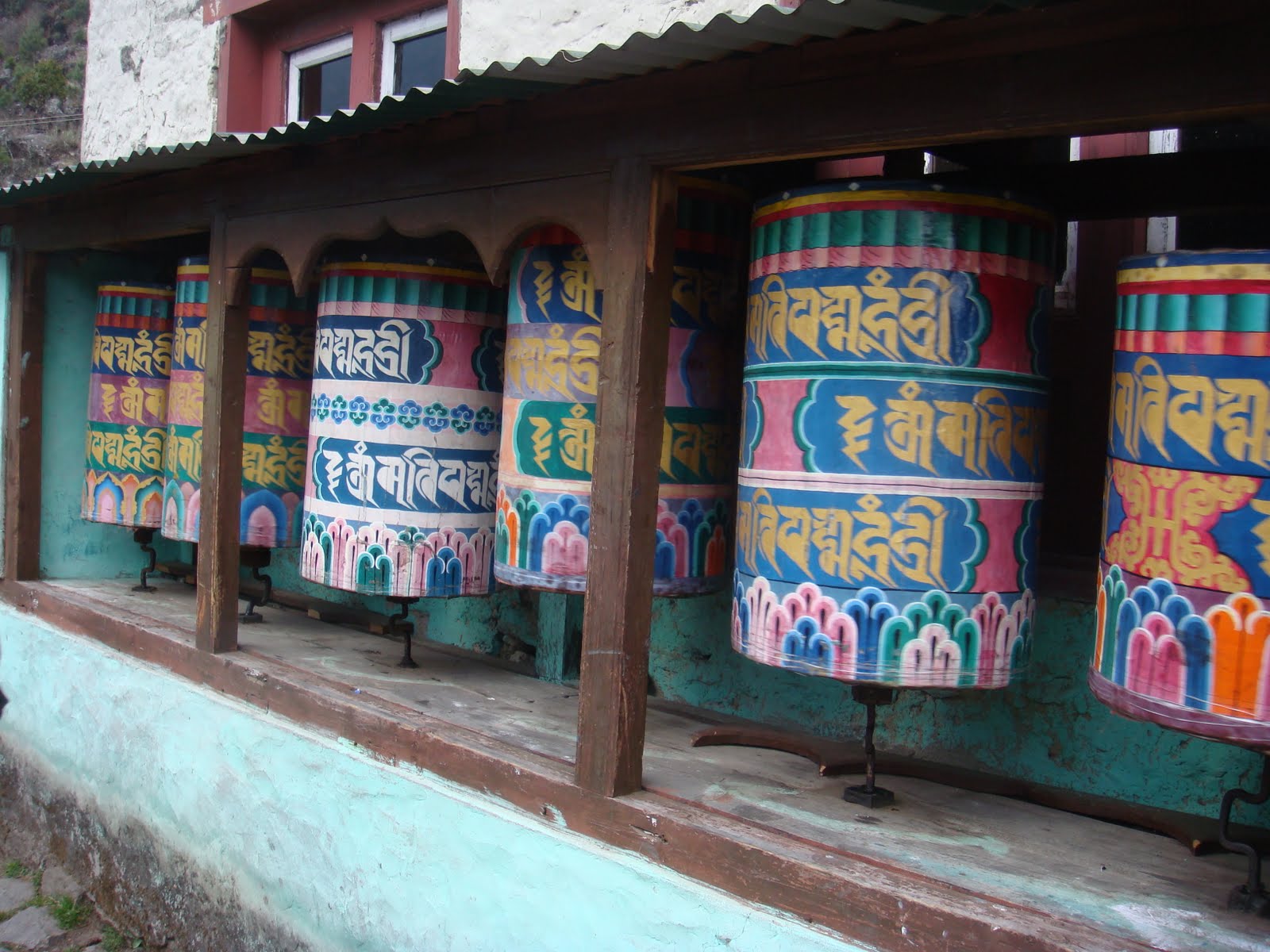
Buddhist monasteries, prayer flags, stupas and sacred writings. As you enter the mountains, you find mostly Buddhist people.


Dudhkoshi river – blue green after its confluence with Botekoshi coming from Tibet.
Dudhkoshi comes from a pond in Gokyo that is white in colour like milk and hence the name.


I trekked mostly all alone to keep my field of view clear of people during photography.
I did not rest stop even once during the trek. Except for taking pictures.

Thanks to those who were sensitive to stand aside, away from my field of view while I took pictures. There were a few who, even after I requested explicitly to stop for a minute, continued walking on the narrow trail causing me to wait until they had passed.
Well, there are two types of people in this world – those who stop for others and those who don’t!
: ) every predicament offers some opportunity for philosophy.

And finally we reached. This was our hotel.


It was cold. People were sitting huddled together, shivering, holding hands and all.

A surprise awaited me (all of us) at Phakding. If you wanted to use electricity to charge your phone, camera etc., you were charged 100 Nepalese rupees per hour.

‘It gets more expensive as you go up’, we were told.
‘I will have to be more judicious while taking pictures’, I thought.

One bucket of hot water cost 100 rupees.
One mug for washing face cost 10 rupees.

All kinds of jokes started were going around. Context is a powerful thing.
There were jokes about the idea of people bathing together, not bathing at all. A boy was rubbing another to keep him warm – and that triggered this idea of people sleeping with a bucket of cold water in between them in the night so it would become hot by morning and they could save money.
People joked about dividing the job of photography as well when they learnt electricity had to be paid for through the nose.


Wednesday, July 20, 2011

Everest Calling - Crash Landing Into Lukla


17th April 2011
By now it seemed like I was jinxed. I and roomy were left in the hotel while the rest of them had left to the airport in the bus. We reached the airport by a Maruti 800 arranged by our tour organizer. My guilt for the delay was lessened however by the fact that we carried eleven sleeping bags with us stuffed into the little space around us in that matchbox like vehicle.

We were 29 of us in all. The first chartered flight had left with half the people in our team. The rest of us would be taking the 2nd chartered flight leaving at 8 : 40.
I was not even asked to show my passport or any other ID card /proof as I entered the airport. A word by our tour organizer was enough to get us in.

This part of the airport looks like a railway station. With the exception of yours truly, everyone checked in their luggage. I would carry both my bags with me. (Paranoid!)


Our team was gathered before Sita air.


Another airline was called Yeti airline.


After collecting our boarding pass, we moved to a lounge.

There were a few shops. I wanted a travel guide book on Everest region. It cost 2000 Nepalese Rupees and another, 3000! I put it down and decided to buy one after returning to India.

Currency Conversion: 100 INR = 159 Nepalese Rupees.
So when they gave you the price of something in Nepalese, you knew through quick mental calculation that it was less than 2/3rd the number in INR. 100 Nepalese Rupees = less than 66 INR
That was easy.

I noticed while driving to the Airport that all the shop names were of Sanskrit origin except Suzuki and the like.

The flight to Lukla was a narrow small chartered plane – Sita Air. No one at the airport seemed apologetic about the one hour delay. Apparently, this was the plane the first batch had taken to Lukla. It had to drop them and come back for us.


The interior was worn out – yellow brown leather/rexin covered seats that bent forward and backward limply as if they were broken at the hinge. There were 2 rows with a narrow passage in between.
But they were certainly more comfortable than those Kingfisher seats!
We were welcomed with Mango candy and cotton pieces (meant to be used as earplugs) by an air hostess who wore a lot of make up and cream coloured thick stockings. Her legs looked like extensions of her hands.


The scene below, as we took off contained mostly terraced mountains - after we had left Kathmandu, that is.


The terraces were beautiful. I took some pictures and soon gave in to sleep instead of trying to fight it.


After some dozing, I opened my eyes and lo! there were snow covered mountains on our left, one of which we hoped was Mt Everest, camouflaged among the other mountains. We were not sure which one but we fixed our eyes on the one that looked fancier than the rest.
Something as high sounding as ‘the tallest mountain in the world -above all the world and eternal’, had to be something very fancy looking as well.
It would be quite sometime before we realized how mistaken we were.


Then suddenly we came closer and closer to the green-brown mountains below and before I knew whether to feel thrilled or to panic, we crashed into what must have been a mountain slope. I shrieked. For all of us. We were thrown forward towards the seat in the front. Our plane continued moving and then came to a sudden stop.
Well, that was the dramatic landing.
Laughter followed.


Lukla is one of the most dangerous airports in the world. Perched on a hill top it is really small. The runway must be less than a hundred meters long. The gradient of the runway or the slope acts as the breaking mechanism for flights during landing. Because of this, the landing feels like crash landing! You crash and before you know what next, your plane takes a right turn and stops.
I was told later that our pilot had been a woman. And that too a trainee! God. We must be lucky. The guys in the seats close to the cockpit - which happened to be an open cockpit - were taking pictures of it and the hundred different controls.

Another thing we learnt about the Lukla airport was that it is one of the busiest air routes in South Asia. You miss a plane and you have to wait for a week before you can get a seat on another plane or trek to Kathmandu (or was it take the road) which takes seven days! They fly only in the morning due to weather conditions.

The picture that awaited us when we landed in Lukla, although quite ordinary in retrospect compared to the spectacular ones we would see day after day for the next 15 days to come, seemed refreshingly clear, stark, bright and breathtaking after the distant, elusive, nebulous mountains in the midst of clouds that we saw while flying.


On our way out of the airport, we watched some chartered flights taking off. After a short taxi, the planes were the air, the ground beneath them suddenly pulled away! Quite dramatic.


We were to start trekking to Phakding the same day or our stay at Likla was for a few hours to help us sort of brace ourselves for the trek – have lunch, make small purchases from the bazaar, change into warm clothes, etc.

Our station was the very first building of the long narrow strip of bazar that was made of buldings that housed restaurants, shops, rooms for stay, bakery that lined both sides of one straight road that merged in the end with the forest trail that all tourists eventually vanished into.


There were Scottish pubs and Irish pubs in almost all villages where we stopped!


We couldn’t believe there was a Starbucks shop in this remote village. Don’t think it was original.

I bought a second hand chadi for 300 Nepalese 180 – Indian Rupees.
Althought I had a cap, I bought a hat for complete protection from sun on all sides.
The next was an orange scarf. Two ends of a rectangular piece of cloth stiched together to form a silken cylinder, it was not tied but pulled down the head to neck where it remained a crumpled band. When the cold winds started hurting your lungs, you slipped the band up over your nose so only your eyes and forehead were exposed. This was really useful.

The dining area.


A bland lunch of boiled vegetables, rice (fortunately, it was soft), and Dal was served. The taste was close to Chinese.
The homemade pickle of carrot and radish did not appeal to me.


I put on my woolen inner wear which I would keep on for the next 15 days. The porters were ready to carry our burden. I saw that my baggage was the lightest of all. I was carrying very little – no energy bars, chocolates, biscuits – only 2 sets of clothes, a pack of walnuts, paper roll, and such… the rest was in my backpack which itself must have weighed 2 kilos.

I had coffee cake at a bakery for 190 Nepali Rupees. It was good looking but tasted just OK.


Ambling through the market, camera in my pocket, chadi in my right hand, I vanished into the forest trail.


Thursday, July 14, 2011

Glimpses Of World History - Jawaharlal Nehru


A sincere, methodical reader of books as I am, I deferred the reading of certain books, set in foreign countries like China and Russia because I did not have sufficient knowledge about the socio, political, economic, cultural background of these counties and hence would not be able to get a full appreciation of these works.

A compilation of letters written to his daughter Indira from prison, it is simple, easy to read and intermingled with personal accounts. It makes effortless reading; in fact, it required less effort of me than Discovery of India did. The providing of several maps of different time periods helped in gaining perspective.

Narration, language and style are simple but of a good standard.
But given the fact that he was writing all these letters to a 13 year old daughter, the standard seems a little too high for us to believe that those letters were meant for his daughters alone. Added to this, the fact that all letters were carefully preserved and numbered confirm that when he wrote, he did so with the intention of getting them all published and hence had in mind a larger audience.
If he thought we, his countrymen, were naïve enough not to guess it, which he probably did, habitual as he was of underestimating the masses of his country and talking down to them, he was mistaken.

The book is voluminous but not formidable. It is rushed at certain places, but it does give the reader, as it promises, glimpses of world history, allowing him to sample various pieces if it so he may pick pieces he likes more for deeper study.

A must read.

Having said that, I must warn you to be careful while reading Nehru’s works, as he is highly prejudiced.
Even as he advises his daughter to be careful while reading history, to steer clear of biases, not to judge the past and to look at it with sympathy and all that, he is presumptuous enough to judge religion, to judge an entire class of people-the Brahmins, to judge rulers and emperors categorically and more. To make his judgment worse, he is partial. To give you a drift of the direction in which his opinions and prejudices are inclined, he slights religion, he is anti Brahmin and he is pro Muslim.

Though he writes about the subject of history, his language or tone wavers from that of the unbiased historian’s and becomes sarcastic here, slighting there, humorous here and ridiculing there...it makes interesting reading though.
His choice of words which is derisive in places where he discusses religion, Brahminism, European crusaders, and even Alexander the Great, it turns grave, serious and matter-of-factly, when the narration turns to Muslim rule.

All the above notwithstanding, he is very proud of India and makes the reader very proud of being Indian. He frequently quotes visitors and foreign tourists who had great things to say about India.

The book is one thousand and one hundred plus pages long. I initially took notes, but every page had some point noteworthy and taking notes slowed my reading terribly. So here are a few points I noted now and then...

ANTI BRAHMIN, PREISTHOOD AND RELIGION

He calls people bathing in Triveni-Sangam a burden of tradition. He finds it unreasonable that religious people should think of other world and says he is bothered only about his duties in this world. Duties in this world are important, sure, but undervaluing spiritual interests is downright ignorant of Nehru.

“Whatever happens in a family - a birth, a marriage, a death - the priest steps in and payment is required…”, and much more has been said about Brahmins.
While a lot of it might be true, the other side of Brahminism - preservation of culture, tradition, heritage and legacy that give India its identity which was solely the responsibility of the Brahmins is not mentioned at all, making Brahminism a completely dark thing - which is far from truth.

He calls Jauhar a terrible rite...
This one beats me......”Chittor, the home of romance and chivalry, full of courage, but even then old fashioned and sticking to outworn methods of warfare, was overwhelmed by Allauddin's efficient army. There was a sack of Chittor in 1303, but before this could take place, men and women of fortress, obedient to old custom, performed the terrible rite of Jauhar - when defeat threatens and there is no other way, it was thought better for men to go out and die in the battle and women to burn themselves on a pyre. A terrible thing this was, especially for the women...”

Firstly, Indians practising chivalry in warfare is a matter of pride. Dharma Yuddha - fighting by rules laid down to prevent disruption of normal functioning of the State, as opposed to blind pillaging, plundering and destruction, is a matter of pride. He says Chittor was ‘sacked’ by Allauddin’s ‘efficient’ army!

And women jumped into the burning pyre to save their honour which they valued above all else in life. They preferred honourable death to coercion by lecherous men of the enemy and lifelong confinement to a harem guarded by eunuchs. Nehru calls this a terrible rite!

“China has never been the slave of religion and has not had any priestly hierarchy. India has always prided herself on her religion and her society has been priest ridden in spite of Buddha's attempts to rid her of this incubus.”
“An interesting development in China was the displacement of religious authority by secular authority. Education was secularized. The most obvious examples of this process are afforded by the use to which many old temples are now put. In Canton, a famous old temple is now used as a police training institute. In another places, temples have been converted to vegetable markets.”

PARTIAL JUDGMENT - MUSLIM VERSUS OTHER RULERS

On Alexander the Great, he says what was so great about him?
He condemns Theodosius the Great because he destroyed old temples and old statues which were the religion of people before Christianity...he was a strongly opposed to non Christians also to Christians who were not orthodox...
But elsewhere he does not condemn the destroying of Hindu temples and plundering and pillaging by Muslims.

He justifies all the savage invaders with one clever argument or another.

“The Muslims who came there - remember they were central Asians and not the Arabs - were full of zeal for their religion and wanted to destroy idols...but another reason for their destruction was perhaps the use of old temples as citadels and fighting places...that explains why Muslim invaders destroyed them...”

“Mahmud Ghazni - he was hardly a religious man. He was Muslim but only by the way. Above everything, he was a soldier and a brilliant soldier. He came to India to conquer and loot, as soldiers unfortunately do, and he would have done so whatever religion he might have belonged to...he threatened the Caliph of Baghdad, and the Muslim rulers of Sindh...we must not fall into the common error of considering Mahmud as anything more than a successful soldier.”

A lot of significant events that would have shown the Muslim kings' unworthiness of trust, cunning and deceit have been omitted.
For instance, just a line saying “Shahab Ud Din the afghan defeated Prithvi Raj.”
The story about how Prithvi Raj who forgave the captive Muslim king and spared his life was killed deceitfully by him is omitted...
The story of the Khilji king coveting the queen of Chittor and attacking Chittor only to abduct her is omitted.

“They(Muslims) were considering India their home. Allauddin married a Hindu lady and so did his son...”

Khushwant Singh, in his ‘Delhi’ says...”Allauddin Khilji was a homosexual, a fallen depraved fellow, whose pastime it was to have elephants thrown down valleys and in whose time, kingdom suffered...”

They abducted Hindu women and made them part of their harem. Even they married a Hindu woman, it was probably because she was renown for her beauty. Akbar married Jodha Bai – so people have been told from rooftops. What people don’t know is that he had a harem of 5000 – yes, five thousand women, and Jodha Bai was the only woman to enter his nuptial chamber twice – because she was his favourite beloved queen!

There is one line about Timur's intentions to massacre and destroy.

Khushwant Singh in Delhi writes, “he massacred 50000 people of Delhi with his scimitar... he found delight in raising pyramids of human skulls”

“...the tremendous energy of Mongols seemed to be lessening...the impulse to go on conquering waned...”
I am looking at his choice of words here...tremendous energy…which should have been ‘brute force’.

“…As the country went to pieces, arts fell with it. They lost vigour and life and became overburdened with detail and sometimes even grotesque. The coming of Muslims gave a shock and brought new influences with rid the degraded forms of Indian art of over-ornamentation. The old Indian ideal remained at the back, but it was dressed up simply and gracefully in the new garments of Arabia and Persia.
...the greatest triumph of the Indo Persian art is the Taj Mahal…”
His point about over-ornamentation and too much detail gives a useful insight into the approach to art, that certain Indian cultures had during certain time periods; an approach that was characterized by admiration for complexity, achieving of grandeur through complex undertakings and forgetting simplicity somewhere along the way.
But instead of being objective in his observation about this, he uses adjectives like decadent, grotesque, which is most disagreeable.

He does not forgive the cruel history of the church though. Spanish Inquisition, Crusaders, Roman Church, the struggle for power between two churches…

WORLD CONTEXT THAT PUTS INDIAN ISSUES IN CORRECT PERSPECTIVE

Though Nehru might not have written the below with the intention of putting in perspective the negligible magnitude or severity of Indian issues in the larger world context, I noted the below points for they made India’s much criticized issues seem very understandable and forgivable in the context of the terrible, monstrous things that were happening all the world over.

“Most of the glory of ancient Roman and Greek civilization was built upon mass slavery. Salves were treated with brute force and savageness. The gladiators were made to fight each other and die to provide entertainment to people. These were slaves.
Although India had it's caste system, people had freedom to live as they want within their castes and within their community - they had their gatherings, festivities. There was no brute force and no savageness. Even the small population of slaves that existed in India were mere domestic helps and were not subject to hazardous drudgery.”

Giving the example of Chaaravaaka the atheist who did not believe in God, and his works, he says, “There was freedom of thought and writing in India in the olden days. There was freedom of conscience. This was not so in Europe till very recent times.”

Crusaders - the brutal, savage history of the two religions Islam and Christianity - 'in Jerusalem, 'Under the portico of the mosque, the blood was knee deep and reached the horses' bridles'

Exaggeration of Hindu Muslim problems – “There is a tendency to give them far more importance than they deserve. Every quarrel between Hindu boy and Muslim boy is considered a communal quarrel, every petty riot is given great publicity. We must remember that India is a very big country and in tens of thousands of towns and villages, Hindus and Muslims live at peace with each other, and there is no communal trouble between them.”

“A good government is no guarantee against foreign invasion.”

“In 1840, the first world's anti slavery convention was held in London. Women came as delegates to it from America where the existence of Negro slavery was agitating many people. The convention however refused to admit these 'female delegates' on the ground that for any woman to take part in a public meeting was improper and degrading to the sex!”

NEHRU ON SOCIALISM

“...it is the twilight of capitalism which has lorded it for so long over the world. And when it goes, as go it must, it will take many an evil thing with it...”
How mistaken Nehru was...!

“Economic domination is worse than political domination”

“Capitalism produced socialism, Imperialism produced Nationalism”

“Internationalism is the foundation of all progress. Socialism works internationally but not in only one nation.”
It seems, Nehru was for free market, opposed to economic nationalism and opposed to protecting national markets by imposing tariff on imported goods.

“Growth of industries, products, aggressive search for markets and raw material for industries - rivalries of diff industrial powers – all these led to war”

“The acquisitive economy and this policy of individual grab with no planning with its waste and conflicts and periodical crises must go. In its place some form of cooperative economy must come.”

INTERESTING THOUGHTS, LINES, FACTS & INSIGHTS

...people have leisure... so what is called civilization develops…

Beauty has three levels - Indication, Expression and Exposure. Spirituality indicates, art expresses and science exposes…

The man who has got everything he wants is all in favour of peace and order...

No man can succeed in great tasks unless the time is ripe and the atmosphere is favourable. A great man often forces the pace and creates his own atmosphere. But the great man himself is a product of the times and of the prevailing atmosphere.

The idea of human progress is a modern notion. There seems to have been no such idea in the past in Europe or Asia, or any of the old civilizations. People looked upon the past as an ideal period like the old Greek and Roman classical period. Indians looked at Satya Yuga, Dwapara Yuga… and all believed in deterioration or worsening of the race.

What is Marxism? – it’s a way of interpreting history and politics and economics and human life and human desires. It’s a theory as well as a call to action. It’s a philosophy which has something to say about most of activities of man's life.

There was false propaganda by armament industry to promote war - media, rumours etc. the same with most selling and marketing industry today.

The old religions have a way of covering and regulating every aspect of our day to day lives. Hinduism and Islam quite apart from their purely religious teachings lay down social codes and rules about marriage inheritance civil and criminal laws, political organization, and everything else. They lay down a complete structure for society and try to perpetuate this by giving it religious sanction and authority.

Humour and sarcasm - British professing to be the trustees of the dumb millions...
“Incidentally this process of conferring benefits often resolved itself into shooting down large numbers of the people benefited. Perhaps in this way, they were made to escape the miseries of this world and their departure for paradise was hastened.”

Inflation in Germany went to a point (post war) -they printed more and more notes that had less n less value - a postage stamp for a letter cost a million marks (German currency)!

Women in Russia have perhaps more freedom than in any other country and at the same time. They have special protection from the State. The first woman ambassador appointed by any government was the old Bolshevik Madam Kollontai.

The great depression and world crisis- In highly industrialized advanced capitalistic America many people took to the ancient method of barter which had existed in the old days before money came into use. Hundreds of barter organizations developed in America. Exchange associations arose to help this barter by issuing certificates. An interesting instance of barter was that of a dairyman who gave milk butter and eggs to a university in exchange for the education of his children.
England bartered coal for Scandinavian Timber; Canada gave Alluminium for soviet oil; US bartered wheat for Brazilian coffee.

War is not a pleasant subject to contemplate in all its horrid reality, and because of this the reality is hidden behind fine phrases and brave music and bright uniforms.

Plato held that slavery was essential. There was much effort to retain slavery in America!
We cannot judge the past from the standards of the present. It is equally absurd to judge the present by the standards of the past.

Often past is jealous of the future and holds us in a terrible grip and we have to struggle with it to get free to face and advance towards the future.

Karl Marx says "History has no other way of answering old questions than by putting new ones.'

A MUST READ.

Wednesday, July 06, 2011

Not So Simple After All...


It’s not almonds, its ‘aamonds’. The L is silent, said I.
'Look, I am a simple guy. I don’t understand all that', came the defense.
‘Simplicity has nothing to do with mispronouncing words’, I had to assert, almost indignantly.

‘Me and my friend went shopping.’
“Its ‘I and my friend went shopping’”.
‘Look. I am a simple man and don’t get into such minute details’.
‘Simplicity has nothing to do with deviating from correct grammar’, I was pleading this time.

The excuses people use to justify their shortcomings!
Imagine sacrificing simplicity at the altar of all your flaws - slovenliness, purposelessness, inferiority, existentialism, hypocrisy, clumsiness...and what not!

I have this bunch of relatives(15 -20 years senior) who have been used to barging in to our home whenever they feel like, becoming too comfortable, behaving like family members, giving unsolicited, unwelcome and outdated advice, throwing their weight around, complaining to our father about us and watching our humiliation with hungry eyes. Hate them.

Even when it is absolutely uncalled for, they compare themselves with us and try to prove that they are better.
This one happens to be a rough uncouth woman. Blue sari, pink petticoat, yellow blouse, lot of hair that she never tires of boasting about but combs once in a week...
We don’t ask for an explanation. No one grimaces or says anything.
But when she sees us neatly dressed, she HAS to say, 'We are simple people, not stylish like you. We don’t do fashion.’
The dumbass doesn’t even know that one does not 'do' fashion, one 'follows' fashion or one does not.

The more important point here is, simplicity does not mean shabby dressing!

Some more. She talks with her mouth full of curd rice. Or chapatti. Or whatever food.
She eats noisily.
I suggested to her that she should finish what was in her mouth and then talk, talk in between morsels never through the morsels.
Food in her mouth, she says. 'We are simple people. Not sophisticated like you. We don’t like sophistication.’
Dumbass! It’s only DECENT not to talk when you are chewing. There is no sophistication in it.

I don't have great table manners. What do I do? I simply admit it. I don’t laugh and say 'I am a simple girl'.
I just admit it and don’t justify it.

Soon as I turned 25, my parents started groom hunting for me. I met a motley mix of suitors.
‘So tell me about yourself. What do you do?’, he asked over some pizza we were having in this pizza hut next to my house.
‘Well... I read...I write... I am a member of the Toastmasters Club...I travel…I used to paint...once in a way, I write poems, when inspired you know...
He raised his brows, ‘Hmmmm....interesting…well, I am a simple guy...I don’t have hobbies...I go out with friends... watch movies...I am a very simple guy'

It’s perfectly OK not to have interesting sounding hobbies. I have met some very interesting men who do not really have hobbies to boast of. But using simplicity to justify it? Where is the need to even justify it in the first place?
And what has simplicity to do with having no hobbies?
So you mean, people who do have hobbies are complex and complicated?

Boy rejected. For having stupid notions about simplicity. (Among other reasons)

Simplicity also comes handy to those in the field of writing and speaking who aren’t willing to work hard, who have no talent, have no sincerity, but want rewards and recognition nevertheless.
I used to be a member of this forum for public speaking where people delivered speeches.
Most of these speeches were without substance.
They were neither interesting, nor well researched, nor deep, mostly cliche, not to mention bad grammar and poor vocabulary.
Some high sounding well selling subject, not necessarily close to the heart would be chosen. An acronym, a few jokes mostly irrelevant to the subject, material from the ocean that is the world wide web, would be thrown in to draft a speech in badly formed sentences.
And delivered before an audience that had braved Bangalore traffic on a weekday to get to the forum from faraway corners of the city.

And what was the justification?
'Simple message in simple words, you know. You need not be verbose, use big big words, talk about issues of national significance only, even a simple topic...’
Very convenient. Very clever.

Simple or otherwise, the speeches delivered were extremely poor and not worth anyone’s time.

I don’t have any problem with simplicity. A simple message can be significant. But a message, any message has to have certain qualities.

It has to be sincere. You have to say what you mean and the subject has to be close to your heart and not merely a subject that’s hot in the market - like Motivation. God! Everywhere you go, you find motivational speakers, courses, books, life transforming programs!

Originality. This world is such an old place that there are no new subjects. But the same old subject can be discussed with newer examples and anecdotes from the current time and context. If it is a subject close to your heart, even if it is a hoary old topic, like honesty, like love, like environment, you will sound original since you will have 'your' viewpoints, 'your' examples, 'your' anecdotes to tell that have not been told before.

Language matters. There is a difference between complexity and complication. While complication should be avoided, complexity has its own beauty. You should read the classics, the beautifully formed sentences to appreciate complexity.
Further, there is difference between brevity and economy. While brevity requires short sentences, economy does not. Economy simply means avoidance of redundancy. Somerset Maugham’s writings, characterized by long sentences, some of which make up one paragraph, even one whole page, are known to be economical. Such long sentences can be simple too.
Simplicity does not imply brevity.

Lastly, grammar is what separates wheat from the chaff.

The bottom line is that, a simple speech does not mean broken ungrammatical sentences, cliché, badly formed sentences and lines that people have heard a thousand times.

The same applies to the literary world as well. Most of these self help books are badly written - subjects that are hot in the market, a few mantras thrown in, easy to remember acronyms, no depth, content gathered after combing all the SMS’s and email forwards (about a man busy making money repenting after his mother’s death – therefore live your life! And all that…) that have done a few rounds in the 8 years or so, aggressive propaganda through facebook and twitter,…

And those who like such books defend it using simplicity, the poor thing. ‘A book need not be like those classics having a high standard. It can be a simple book…’

Like I said, there is no end to the altars at which simplicity has been sacrificed. Slovenliness, purposelessness, inferiority, existentialism, hypocrisy, clumsiness, lack of talent, ignorance...

I will share with you one last example.

'I will marry any boy you find for me ma'. That wasn’t me. Oh no! Not at all.
That was a friend from the Marwadi community - educated in a top university, good looking and placed in Infosys...
‘I am so evil’, thought I who definitely had 'expectations'.

'I am a simple girl yaar, main kisi se bhi shaadi kar loongi. I am a simple girl. It’s all about making it work. It’s not about finding the right guy. You need to be more mature and practical yaar’, she advised me 'Say yes to someone. Don’t reject all boys like that'.

A few months later, she told me she was in love with this guy, a colleague from another team. They were about to be engaged. She had begun her shopping too.
And then she called off the relationship.

‘His family is more orthodox than ours. You know how Marwadis are...’
‘But you will have a separate home in a distant city... you will not live with them’, said I, feeling sad that lovers were parting.
‘Yes. But we will have to visit our in laws and stay with them at least once in a year.’
‘That’s just for 10 days.’
‘But those 10 days will be my vacation too, not just his. He will sit before the TV, remote in his hand. I will be with his mother in the kitchen doing seva, my head covered in a pallu’.

I simply sat there listening, not sure what to say. She shouldn’t have called it off... she was in love with him...this was a small sacrifice...though easier said than done.

And then, tumbling came other reasons too...
‘His salary is another thing yaar. I am getting 6 lakhs per annum he is getting 8 lakhs; it’s just a difference of 2 lakhs.
‘How does salary matter?’ I asked.
‘It matters yaar, it matters. Guys have an ego. And then it’s also about my position in the family.
My bhaiyya is getting 18 lakhs per annum, and my bhabhi knows it and is proud of it. If my husband earns less than my brother, then what will be my position in the house, in front of my bhabhi?
‘Why do you care? You will not live with your bhabhi.’
‘But I will visit them once in a year. Tab mera position kya hoga?’

What had she said earlier? 'I am a simple girl yaar'. 'I will marry any boy my mother finds me'?
Very simple indeed! I thought!
And I was relieved to realize that I was not all that evil after all. I had not asked a single suitor how much he earned!

So that was about the use, overuse, abuse and misuse of simplicity.
What true simplicity is, is a subject for another discussion, another day.
What I know for sure today, is that, simplicity is none of what it is made out to be by people. Simplicity has become a fashion, a fad. People go for an image makeover so they will ‘look’ simple!
And then, it is a handy instrument for all those who want to justify their ineptness in one way or another.

Leave alone practicing simplicity, even understanding simplicity, is not so simple after all.
Isn’t it?