
Friday, June 10, 2011

EC - Flying and Scrambling, Crouching and Racing


It was a bumpy plane ride; the worst of all I have experienced. I was half asleep and therefore less afraid.
My father had mentioned air bubbles once… it seems the air hostesses had abandoned the food carts/trolleys right in the middle of serving and fled…
Were we passing through one of those bubbles now? Or was it something else?
It felt like driving on roads with alternating road humps and potholes.
I could actually feel the plane diving suddenly and my heartbeat stopping every time that happened.
And I smiled away foolishly, eyes closed, rather enjoying the boisterous slapstick comedy, not caring to fear, sure of my destiny, for no reason at all.

Another feature of this ride was the impervious-impermeable Vada that was served alongside Idly. It was so impervious to the hot Sambhar in which it was immersed, that it was brown on the outside and when I bit into it, it was spotless white inside. As I chewed, there appeared Vijay Mallya on the screen before me, proclaiming he had tasted the food personally and made sure it was perfect.

We were flying cattle class in Kingfisher.
The seats were closely packed. The namesake reclining seats moved only 2-3 inches backward while I continued pressing the button and pushing the back of the seat with all my might.
The Bangalore – Delhi journey was miserable!
And the little speech by Mr. Mallya was a source of comic relief to one and all.
“The airhostesses have been personally chosen by me…! “
Yes. We believe you.
I thought of a joke by a friend during peak recession “Why King Fisher employees need not worry about being laid off?
Because they have already been … … by……
Ha ha ha…
Sorry about the crudeness.
The very plastic, artificial Yana Gupta was giving security instructions in Hindi on the small screen pausing between sentences at all the wrong times…

‘Hum aapko suraksha ke’
Pause
‘Bare mein’
Pause
‘Soochna dete hai’

The Delhi international airport!
Wow!! What a sight! How grand and what aesthetic sense! Every inch of it had received attention.

The first thing I noticed was the carpeting! The complete length of the corridors, stretching up to hundreds of meters was carpeted.
The way it stretched from this end to that, it made me think of Paris airport!


There were conveyor belts to carry people who preferred to simply stand and at the same time be transported to the opposite end of a long corridor.

Every bend and turn at the airport offered a surprise.

High ceilings created an atmosphere of majesty.


In one place, there were Mudras in metallic finish fixed to the wall, that was covered by huge copper coloured concave metallic plates - each mudra being as tall as I am.
There were 10 or more of them in all.


The wall opposite was covered with posters of cricketers.


I had to meet a friend during the three hours I had before my next flight so I moved towards arrivals.

Granite tiles polished to a sheen covered the floor that reflected the hundreds of light fixtures on the ceiling above.


I noticed, there was a long strip of murals covering the length of the building as I walked toward arrivals.
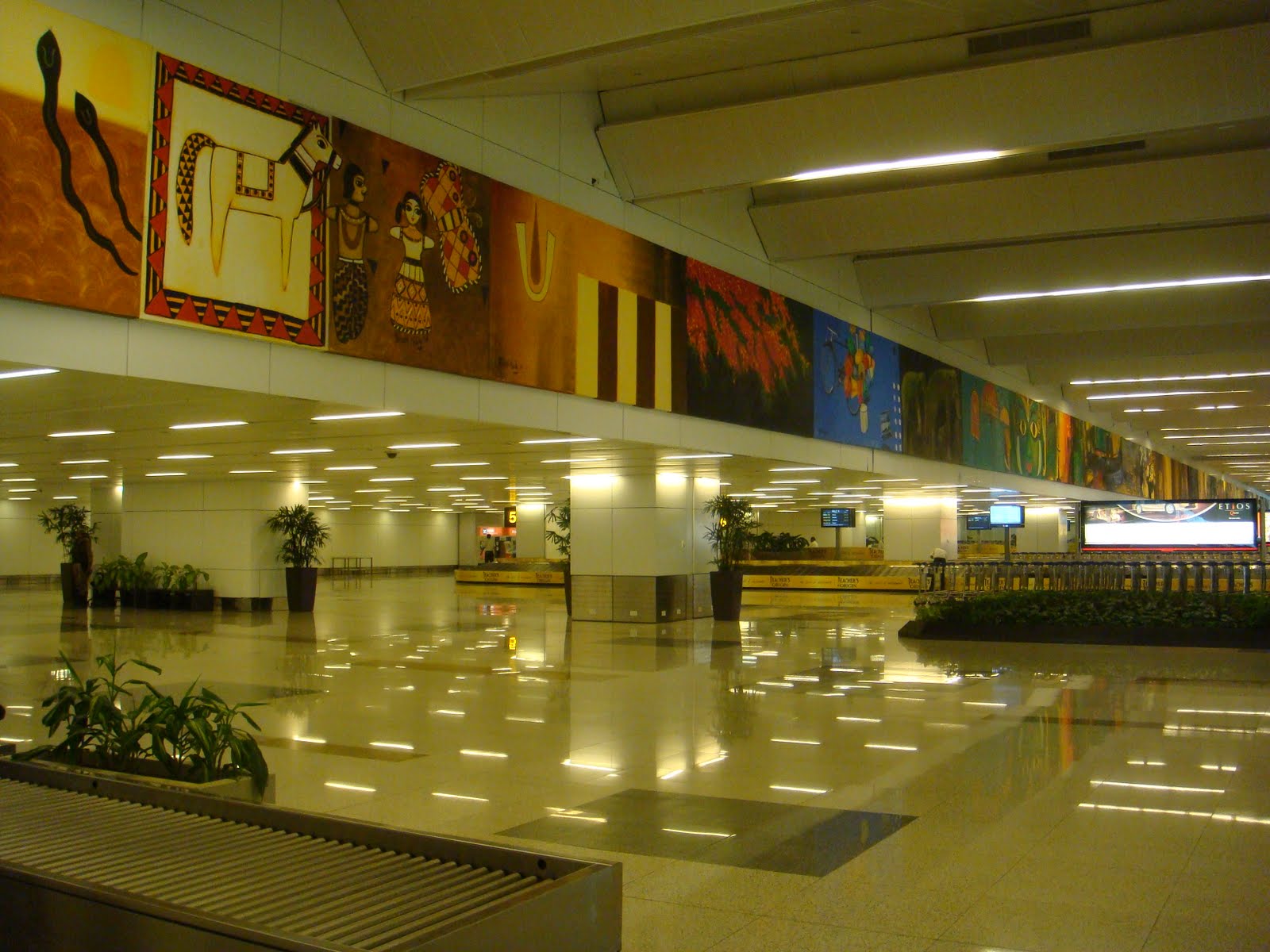


The snake charmer was there; it seems to me that no amount of development - glass finished buildings, malls, computers and all - will take away from the snake charmer, his right to represent India before all else.
Then there were the Classical dancers, Elephants, the Tabla and the Shenai, Tagore…
And this one took me by surprise - the Naama - the mark on the forehead worn by the Iyengars, and the Vaishnavas in general. I was happy to see my community represented.

I did not notice then, but the Taj Mahal was not all pervasive.
I am glad someone had discovered there was so much more to India than a grave.
(Make no mistake; I am emotional about Agra and the Taj Mahal. I spent the first two years of my life there. But definitely, there is much more to India)




I walked slowly towards the exit savouring the sights.


The Hindi translation of Exit ‘Nikas’ caught my attention as I traced its root to a word in Sanskrit that I thought I had read recently.


The arrival lounge is lined with stalls on both sides – stalls of all kind, books, food, bakery,…
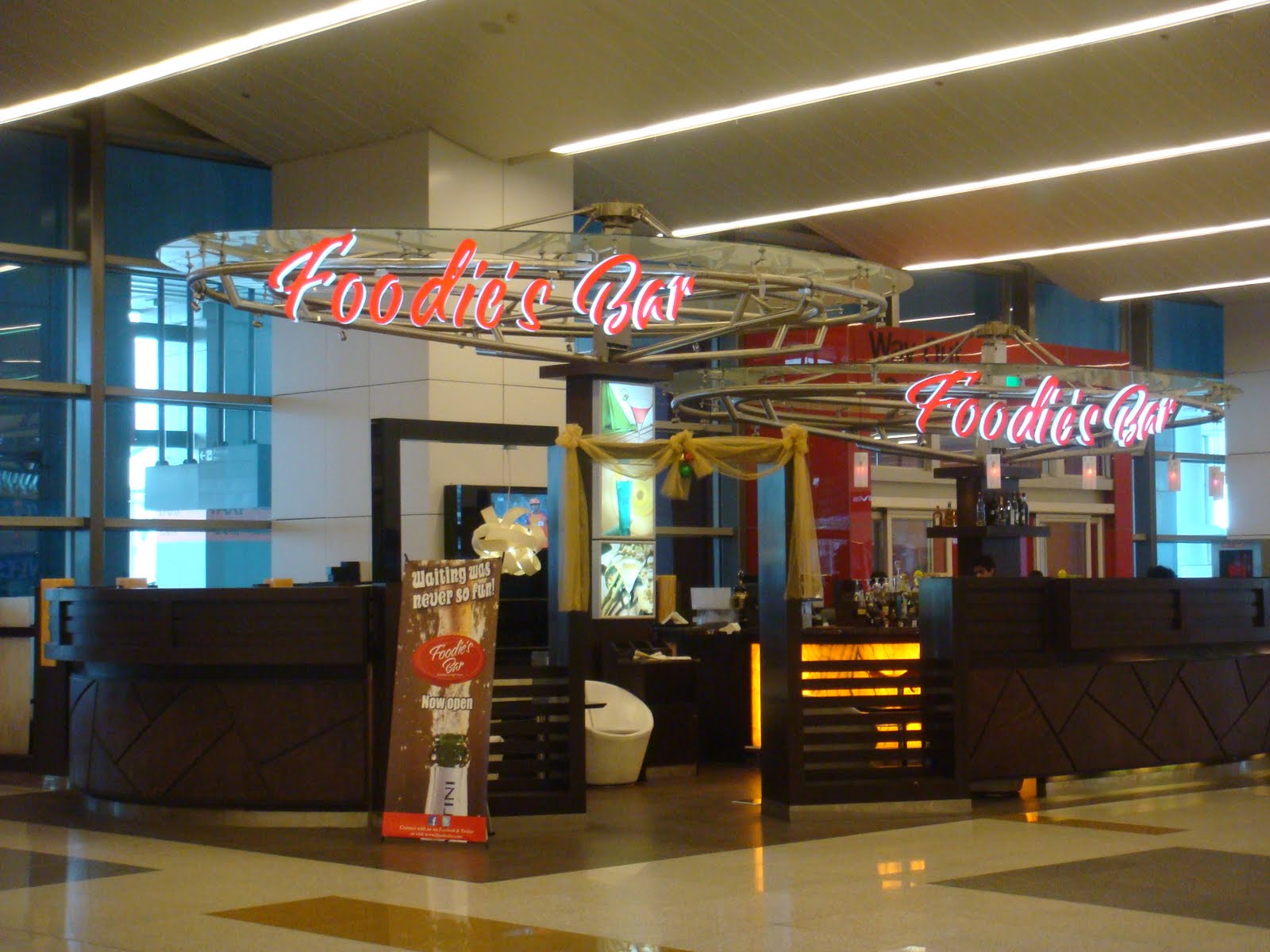

The one that faced me as I entered this lounge was a very attractive ‘Kingdom of Dreams” - What was it? Some agency for booking hotels? That’s what a certain taxi driver, waiting at arrivals said.


When I googled it, I found something very interesting. “Kingdom of Dreams is a spectacular world of unparalleled imagination, which brings to you a blend of India’s culture, heritage, art, crafts, cuisine and performing arts buttressed with the mind boggling technological wizardry of today. This unique tourist destination, situated at the apex of the golden triangle of Jaipur, Agra and Delhi offers you the carnival that is India.”

I will surely visit this place on my next visit to Delhi. The website is so gorgeous.


I saw these metal book marks in a certain shop … stencils of Krishna, peepal leaf, peacock paisley, elephant, flower, lotus and autorickshaw!… 500 rupees each. I almost bought them but held myself.


As I stepped outside the arrivals exit to meet my friend, I saw some more art on the pillars.


Last and the least was this restaurant called ‘food street’ that I walked into, to get some South Indian food. Plain Dosa - 110 rupees. The white chutney which first tasted of ginger and resulted in a good first impression, turned out to be stale the next second. The Sambhar was kind of bitter sour but I was not sure if it was stale. I had to negotiate with three people before I could get a glass of regular drinking water without paying extra.
This restaurant must be a shining example of the decadence that Laissez Faire capitalism can bring about. More on this later…


I had one more hour to go before my international flight took off.
I said goodbye to my friend and moved towards the next gate. My heart sank when I saw the queue. The king fisher staff who filled the form for me at the counter by taking details from my passport…thank you so much…

Once I had my boarding pass, I felt somewhat relieved. I had to reach gate 10B. I had 10-15 more minutes but did not panic since I thought the gate must be close by.
There was no end to the enticing distracting glittery shops and I clicked some more pictures. Anti-consumption though I may be, I could not help feasting my eyes on all the dreamlike material abundance.


I pushed my trolley, walked to this bend and took that turn but gate 10B would just not show. When someone pointed to the bend at the very end of a kilometer long corridor, my pulse began racing. I had no idea Delhi airport was so huge.

I ran with the trolley as a voice announced the last and final boarding call to passengers flying by IT-65.

I must thank the driver of the electric car who went out of his way to escort me. The one meant for passengers shook his head when I signalled to him and drove in the opposite direction. The other who was loading or unloading some goods – drove me to the ever elusive 10B terminal.
I reached, just in time, still panting from the effort of my marathon.

I almost missed my flight twice on the same day. The flight from Bangalore to Delhi had also been a scramble, because we had underestimated the crowd inside. The number of people that had turned up at 5 in the morning! Where were they all going?

Had my mother been witness to all my scrambling, that too twice on the same day, she would have shook her head from side to side until…

So I was inside Kingfisher again, flying cattle class again. The refreshment for this international flight, however, included a chocolate pastry, which I must admit, tasted good.

I had gotten used to Yana Gupta by now.
What kept my childish whim occupied (and amused) this time was a Faux pas.
The recorded announcement said something about alcohol consumption being prohibited on plane and the big prohibition symbol appeared on the screen - on your face.

After water, wet tissue and head sets were offered, the lady in red appeared with “Some beer for your sir?”.
When she tried to offer me one, I asked her about the earlier instruction about prohibition of alcohol, out of idle curiosity (I am a teetotaller).
“That’s for domestic flights only, not international flights’.
Why the message then, I thought?
Cost cutting - by shooting a single video for two messages!
Somehow, cost cutting had characterized several happenings of that day.

By the way, did I tell you where I was heading to?
Oh! I forgot.
Some believe that you do not choose a mountain. The mountain chooses you. Must be true, for I swear I had no plans of going to this place this summer. But long before the onset of summer, a certain mountain, in The Great Himalayas of Nepal, over 29000 feet tall, had chosen me, to take into her proximity.
And here I was, responding to that calling.

Here I was, flying and scrambling, crouching and racing, lumbering and trudging, ambling and hopping and doing whatever else it took to reach the glorious Mt. Everest.


Tuesday, June 07, 2011

The Story of My life - Hellen Keller


Incredible. That’s the one word summation of this book.

It’s the autobiography of a girl who became deaf and blind - and as good as dumb too - because the two important means of learning speech, hearing and sight through which we receive input from our worlds, were lost - when she was 19 months old, but who went on to learn, with the help of her teacher Anne Sullivan, conquered her disabilities and wrote this autobiography full of vivid descriptions of her rich experiences, of her absorption of every drop of life, that inspires those of us blessed with all five senses.

It could have been a book filled with the many deprivations and hardships of the girl, evoking pity and tears in the reader. But almost all the pages are characterized, not by lamentation, but by triumph - over one hurdle after another - evoking wonder, admiration and pride in the reader.

Throughout the book - from the very beginning till the end, the authors tries to assure us that she has ‘seen’ life, just like us.
“…during the first 19 months of my life, I had caught glimpses of broad, green fields, a luminous sky, trees and flowers, which the darkness that followed, could not wholly blot out. If we have once seen, ‘the day is ours, and what the day has shown.’”

Towards the end, after she has described her rich and diverse experiences, her education, her learning, her travel and her adventures, she says,

“Even as the roots, shut in the darksome earth,
Share in the tree top’s joyance, and conceive
Of sunshine and wide air and winged things
By sympathy of nature, so do I”

“…The Bible gives me a deep comforting sense that ‘things seen are temporal and things unseen are eternal’ …”

Only once, in the end, she allows herself one paragraph to share her grief, in a brief message that carries the entire weight of a lifetime
“Sometimes…….. I sit alone and wait at life’s shut gate. Beyond there is light, and music, and sweet companionship; but I may not enter. Fate, silent, pitiless, bars the way…”

One person, who deserves equal attention and appreciation, is her teacher Anne Mansfield Sullivan, who with her patience and her commitment, helped turn Helen, who would otherwise have become a vegetable, into the human that she was.

The methods of teaching she used, to educate Helen, are indeed interesting. Helen’s education, in general, serves to help us understand the challenges that the disabled have to face, even to accomplish very simple things that we pay no attention to.

She(Anne Sullivan) took Helen to the well house where someone was drawing water. Miss Sullivan placed her hand under the spout. As the cool stream gushed over one hand, she spelled into the other hand, the word water, first slowly and then rapidly.

Helen – “…I was stringing beads of different sizes in symmetrical groups…I noticed a very obvious error in the sequence and for an instant I concentrated my attention on the lesson and tried to think how I should have arranged the beads. Miss Sullivan touched my forehead and spelled with decided emphasis, ‘Think’. In a flash I knew that the word was the name of the process that was going on in my head. This was my first conscious perception of an abstract idea.

“My teacher gave me slips of cardboard on which were printed words in raised letters. I had a frame in which I could arrange the words in little sentences; but before I ever put sentences in the frame I used to make them in objects. I found the slips of paper which represented, for example, ‘doll’, ’is’, ‘on’, ‘bed’ and placed each name on its object; then I put my doll on the bed with the words is, on, bed arranged beside the doll, thus making a sentence of the words, and at the same time carrying out the idea of the sentence with the things themselves.

Miss Sullivan’s descriptions of the great round world with its burning mountains, buried cities, moving rivers of ice…she made raised maps in clay so that I could feel the mountain ridges and valleys, and follow with my fingers, the devious course of rivers.

Everything Miss Sullivan taught me she illustrated by a beautiful story or a poem.
What many children think of with dread, as a painful plodding through grammar, hard sums and harder definitions, is today one of my most precious memories.

The growth of a plant, lily furnished the text for some lessons; and also eleven tadpoles in a glass globe.

Miss Sarah Fuller, principal of Horace Mann school – employed the below method to teach her speech : she passed the girl’s hand lightly over her own face, and let her feel the position of her tongue and lips when she made a sound. And the girl learnt six elements of speech - M, P, A, S, T, I.
In reading her teacher’s lips, she was wholly dependent on her fingers: “I had to the sense of touch in catching vibrations of the throat, the movements of the mouth and the expression of the face; and often this sense was at fault. In such cases, I was forced to repeat the words or sentences, sometimes for hours, until I felt the proper ring in my own voice.”

With all her disabilities, the variety of things she learnt and the richness of her experience make a reader ask who is more disabled.

She went to various fairs and exhibitions and learnt the stories of different people and places of the world. At the Cape of Good Hope exhibit, she learnt about the process of mining diamonds.
She learnt algebra, geometry, Greek, Latin, Latin prosody. She learnt Latin grammar from a Latin scholar.
A collection of fossils unlocked the treasures of the antediluvian world for her.
She used to knit and crochet; play a game of checkers or chess with a friend, or solitaire, frolic with children, find pleasure and inspiration in museum and art stores, go to theatre and have a play described to her while it is being acted on stage.
She graduated with honours from Radcliffe College in Massachusetts in 1904.
Talking about her rowing experience, ‘I use oars with leather bands, which keep them in position in the oarlocks, and I know by the resistance of the water when the oars are evenly poised. In the same manner I can also tell when I am pulling against the current. I like to contend with wind and wave…
‘I enjoy canoeing especially on moonlit nights…’ a blind girl you may think… but she knows the moon is there. Just as she could feel the city noises and knew the difference between walking through country roads and city roads. ‘Dissonant tumult frets my spirit…when I walk in the city’…
She was surprised and delighted when she uttered her first connected sentence, ‘It is warm‘. Though she possessed the ability to speak, she could not actually speak as she had no means of learning how to speak - sight and hearing.

There is vivid imagery throughout the book. Coming from a blind and deaf person, such felicity of language is surprising. Most people with all senses functioning couldn’t have done such a good job of imagery...so detailed that its almost photographic - you can conjure the picture in your mind as you read...written with such relish and with so much feeling put into it.

“…..frolicsome streams ran through it from springs in the rocks above leaping here and tumbling there in laughing cascades wherever the rocks tried to bar their way. The opening was filled with ferns which completely covered the beds of limestone and in places hid he streams. The rest of the mountain was thickly wooded. Here were great oaks and splendid evergreens with trunks like mossy pillars, from the branches of which hung garlands of ivy and mistletoe, and persimmon trees, the odour of which pervaded every nook and corner of the wood - an illusive, fragrant something that made the heart glad. In places, the wild muscadine and scuppernong vines stretched from tree to tree, making arbours which were always full of butterflies and buzzing insects. It was delightful to lose ourselves in the green hollows of that tangled wood in the late afternoon, and to smell the cool, delicious odours that came up from the earth at the close of day…”
“……. At last the men mounted and as they say in the old songs, away went the steeds with bridles ringing and whips cracking and hounds racing ahead, and went away the champion hunters ’with hark and whoop and wild halloo……..’
“…Winter was on hill and field. The earth seemed benumbed by his icy touch, and the very spirits of the trees had withdrawn to their roots, and there, curled up in the dark, lay fast asleep…”

She had enough insight and perception to be able to make observations such as below.

“…In spite of Macaulay’s brilliancy and his admirable faculty of making the commonplace seem fresh and picturesque, his positiveness wearied me at time, and his frequent sacrifices of truth to effect kept me in a questioning attitude very unlike the attitude of reverence in which I had listened to the Demosthenes of Great Britain…”
“…but in college, there is no time to commune with one’s thoughts. One goes to college to learn, it seems, not to think...”
‘…Our enjoyment of great works of literature depends more upon the depth of our sympathy than upon our understanding…’
“Calamities…Nature wages open war against her children and under softest touch hides treacherous claws…”
“…Knowledge is power. Rather, knowledge is happiness. Because to have knowledge is to know true ends from false, and lofty things from low. To know the thoughts and deeds that have marked man’s progress is to feel the great heart throbs of humanity through the centuries; and if one does not feel in these pulsations a heavenward striving, one must indeed be deaf to the harmonies of life…”
“…I sometimes wonder if the hand is not more sensitive to the beauties of sculpture than the eye….i should think the wonderful rhythmical flow of lines and curves could be more subtly felt than seen. Be this as it may, I know that I can feel the heart throbs of the ancient Greeks in their marble gods and goddesses…”
“…It seems to me that there is in each of us a capacity to comprehend the impressions and emotions which have been experienced by mankind from the beginning. Each individual has a subconscious memory of the green earth and murmuring waters, and blindness and deafness cannot rob him of this gift from past generations. This inherited capacity is a sort of sixth sense - a soul-sense which sees, hears, feels, all in one…”

She is able to analyze and compare different literatures.
“…The German puts strength before beauty, and truth before convention, both in life and in literature. There is a vehement, sledgehammer vigour about everything that he does. When he speaks, it is not to impress others but because his heart would burst if he did not find an outlet for the thoughts that burn his soul.
Then too, there is in German literature a fine reserve which I like; but its chief glory is the recognition I find in it of the redeeming potency of woman’s self-sacrificing love. This thought pervades all German literature and is mystically expressed in Goethe’s ‘Faust’…. (Chapter 21)
Then she comments on French literature ….and others…”

I have noted some of experiences that are unique to one in her situation and also make up the humour in the book.
Her joy at the Perkins Institution for the Blind - when she began making friends with those who knew the manual alphabet, like her - her joy out of talking with other children in her own language! “Until then, I had been like a foreigner speaking through an interpreter.”
When she first experienced the sea - after her experience with the waves - she demanded “Who put salt in the water?”

One unpleasant incident in her life was the trouble she got into upon publishing a story that she had written. She was accused of plagiarism, tried in a court and convicted.
The author explains, “It is certain that I cannot always distinguish my own thoughts from those I read, because what I read becomes the very substance and texture of my mind. Consequently, in nearly all that I write, I produce something which very much resembles the crazy patchwork I used to make when I first learned to sew… My compositions are made up of crude notions of my own, inlaid with the brighter thoughts and riper opinions of the authors I have read.”

This situation of the author helps us understand how our sense of perception - through which we encounter personal experiences that make us who we are, that make our thoughts, ideas and feelings – is far more important than all the knowledge we gain through reading books, our schooling and university.
Very often we do not think much of our personal experiences and our stories but place a high value on what we gain by reading, on scholarship and on learning.
The author's problem - her only means of perceiving and knowing being books, that makes her incapable of originality in expression and the ensuing result that almost everything she writes has to be plagiarism in some degree, though it is no fault of hers – makes us appreciate better than ever before, how our direct perception and experience are more valuable than all the knowledge of the world gained through great books and authors.

‘There is no way to become original, except to be born so”, says Stevenson, implying that most of us are plagiarists. But the conditions of those like the author, who have no chance at all of being original, help us appreciate how fortunate we are.

As you read about her struggle to get into college and her difficulties in mathematics, algebra, geometry and arithmetic, - interpreting signs, symbols etc., and the system's unforgiving regulations/rules that will not relent just because a student is disabled, you can’t help noticing the ludicrousness of the system. The education system’s flaws loom large before reader.

I will end this post with one line that should inspire all of us to live more of life.
Recalling her visit North, where she ambled in the woods or some refreshing surrounding as that, she says, ‘I lived myself into all things. I was never still a moment; my life was as full of motion as those little insects that crowd a whole existence into one brief day…’


Friday, May 27, 2011

Trembling At The Brim


So much to ask
So much to say
And yet, nothing will be asked
Nothing will ever be said.

Two destinies
One, more cruel than the other
Will be borne in silence
By two beings made of the same soul
That have just found each other,
A few years too late.

As they stand on either side of a chasm
A foot wide,
But an abyss deep,
Tears and words,
Breaths and bloods
Rise to fill the brim of their beings,
Eager to spill, to flow and mix,
And become one soul again;
But hold back and tremble
Forever at the brim
For the waters of forbiddance
Are rising in the chasm below,
Intimidating their advancing steps.

Above the waters, a sky of silence prevails
Between two storm-filled hearts.

A sprout is stifled and smothered,
Just as it has taken it's first breath of life.

Elsewhere the world extols and applauds
The promise and fruitfulness of true love.

Wednesday, May 25, 2011

Morbid Fascination


I was reading this work published by an author, an acquaintance of mine.
Shy, polite, bashful and restrained as he is, I was disappointed and surprised at certain gross descriptions he had filled (unnecessarily) into a few pages.

There was some attempt at double entendre and below the belt kind of humour.
Though it was not in his nature, he had attempted such writing, probably because at least half the humour has its source in such matters.

And the use of the four lettered F word in dialogues was profuse. Perhaps it helps the present generation readers relate to the book better, degenerate and debauched as their own vocabulary is.

This vocabulary has made its way into theatre as well. Actors on stage send out a stream of ‘F this’ and ‘F that’ and ‘F u’ and all other kinds of unspeakable profanity, while spectators, young and old, men and women, married and single, even children watch them without batting an eyelid. If the same profanities were translated into regional languages, say Kannada or Tamil or Hindi and thrown at people, they would grimace. You would hear them whispering ’third class’. Don’t know why people’s reaction to the same becomes one of eager welcome when the language is changed to English!, I mean, American!

There is the argument of ‘we give people what they want’ coming from writers, poets, movie makers, editors of newspapers and magazines and playwrights. Whether it is ‘we give people what they want’ or ‘people take what you give them’ is the eternal, irresolvable question of “who came first - hen or egg?” and the moral police can go on beating their foreheads.
Meanwhile, in the name of presenting ‘contemporary art’ or presenting ‘reality’, isn’t it a smart thing to do to make some money, even though at the expense of legitimizing the dissolute and giving sanction to the decadent?
Yes, you effectively give your sanction. If one artist has done it, many will join soon and then it will become the norm.

While the above(dilution of standards in art) is still understandable (though not pardonable), what I don’t understand(and this was what I was referring to in the opening sentences of this article ) is the morbid fascination that writers, artists all over the place seem to have developed for another four lettered F word; the one people use to refer to intestinal wind.

The very first time I came across the use of this word in literary field was, I think, when I read a work of Khushwant Singh. He had dedicated one whole chapter to intestinal wind and like a true subject matter expert, he had expounded on various aspects such as, the attitude of different cultures towards wind, and then… oh, forget it.
I had, diligently written in my review of the work that, ‘this author has an incredible capacity for distasteful writing’.
While I wondered what sort of a person writes such things and how he faces friends, family and the world, having written such things (I said he, not she; women will take some time before they equal men), while I grimaced at the tip, the rest of the iceberg started looming before me even as I winced.

People were using the word shamelessly.
This guy, who was introduced to me by a friend who was trying to solve my single status, greeted me with flowers (hmmm… gentleman) and within a few minutes of settling down in a restaurant where a play was just about to begin, having heard some sound in that pin drop silence, whispered in my ear that someone behind him had ‘F @#$%^’ aloud!
(disguised as a gentleman….). Sorry friend. You will have to find me a better one.

Before I knew, fellow bloggers had started using the word in their articles.

And then authors. They have been using it generously too.

I fail to understand why this morbid fascination for the distasteful.
The popularity of the rest of those profanities can be explained.
The F word that I first mentioned makes you look ‘cool’, modern and all…(or so the perception is). All the other below the belt talk and double meaning jokes give you some titillation.
But this F word? Just how does it appeal to people? It does not titillate, and it’s just not cool. It’s plain disgusting and loathsome.

If you observe the pattern, right from naming of certain rock bands, like ‘Witches Sabbath‘, ‘Bhayanak Mauth’, to writing lyrics of rock music, to turning our film heroes to negative characters - in one of the movies, both heroes are shown debauching with a dozen women, now smoking, now drinking, now playing Tabla on the posteriors of those dozen women, to using coarse slang in our speech, to projecting ourselves as ‘I am not a Gandhi’ type of a person, to making a mockery of the sober, innocent, honest, decent ones by calling them ‘Gandhi-like”, we display such fascination for the morbid, for the evil and a repulsion towards the good!

One of my friends had left her laptop on the table for sometime and the screensaver appeared - a phrase floating against a black background, moving all over and seesawing. You remember those screensavers?
I looked at it. It read ‘Sexy Naughty Bitchy’.
That was her office laptop. When I asked her if she would change the screen saver when in office, she replied in the negative, to my shock.

Wasn’t it embarrassing, I thought.
Oh! I got it later. It was meant for all to see. And take notice of.
That was the image she wanted to project of herself. Sexy naughty bitchy!
‘I am not a boring conservative good girl. Make no mistake’!, the three words were supposed to convey. And sure, they did.

Coming back to my author friend, I was disappointed when I saw that he had made a mention of that other loathesome F word, quite needlessly in his book and without relevance (he was predicting how a certain character in his story would react if he broke wind in public. My advice to the author - try astrology, but people would want to know about more important events in life.)

When I saw that this morbidity had gripped even my gentlemanly, soft spoken, well mannered, strong willed friend, who is not easily influenced by ‘social trends‘, I knew, we had made the U turn in civilization.

Wednesday, May 18, 2011

What You Speak Is Who You Are


13th and 14th May 2011
Venue: Infosys Campus, Mysore

Two things that made my journey from Bangalore to Mysore as well as my absconding from work, worthwhile were the simply GREAT Infosys campus and the world champion of public speaking (1999), Craig Valentine’s speeches, nay, his performance on stage.

The below is the best I could record between attentively listening, watching, laughing and (of course) applauding through the sessions. As I wrote this article, I realized what a big chasm there was between witnessing the speaker himself and writing about the experience.

Don’t miss the learning below, if you like public speaking. Or writing. Or theatre. Or even simply conversing with people. Or Living!
It was specifically addressed to aspiring speakers but I believe there’s a lot that all of us can take away from his words.

“What’s the number 1 thing that stands between people living their dreams?” he began the session with this question.
“Fear’, ‘lack of confidence’, ‘destiny’… came the answers from us all.
No it’s not a negative thing. It’s a good things that come in between you and your dreams.
This he illustrated with his own story.
He walked to his employer and said he wanted to quit, because he wanted to be the world champion of public speaking. The employer immediately offered him a hike in salary. He shook his head and said he wanted to pursue a career in public speaking. The employer hiked his salary again. And again. And again. When the employer said “I will give you one hundred thousand dollars, he said, “I will ask my wife”.
He went home, told her about it and asked what he should do.
“Take the money fool” said she at first.
And then she said, “wait a minute… this is what you have wanted to do all your life.” Hmm…. Craig, YOUR DREAMS ARE NOT FOR SALE”.
He went to his employer, and without making eye contact, said “My wife said, my dreams are not for sale” : - )

If he had chosen the employer’s offer was definitely a good thing, he would not be living his dreams.
It’s the good that comes in the way of the great.
More often than not, following our dreams means letting go of our chosen safe path and taking risks – risking the good things we have. One who has nothing to lose can do absolutely anything. Isn’t it?
Don’t let the good get in the way of the best.

He told us of the first time he went to a bookstore. And how important it is to read.
“The people you meet and the books you read make you”
He recommended the book “Live Your Dreams” by Les Brown.

The full act on day 2 which followed the trailer on day 1 also began with humour.

“Sales blames marketing. Marketing blames production. Production blames engineers
When the engineers learn to talk, they will blame someone!”

Average leaders blame. Exceptional leaders accept it.

With a few demonstrations involving audience participation, he drove home important lessons.

We were asked to stand up face our immediate neighbour and turn the other way.
Then we were asked to change 12 things about our appearance…
After a few seconds, he said ‘OK, change two things…turn to your partner and find the change”
We did. The glasses were taken off, or the cot was removed, dupattas worn differently, hair let down…
And then again we were asked to turn the other way and change one thing and repeat the process.
We did.
Moral: Change small. Change often.
True. When we were asked to change 12 things, we simply stood thinking. Changing 1 or 2 things at a time was so much more easier.

How to craft/deliver a good speech:
1. Breathe life into a speech
2. Bring the audience to you
3. Build a message – tell a story, make a point

A foundational phrase is important. It is the ‘Take away’ phrase for your audience. It should be fewer than 10 words.
“No phrase. No stage. Don’t talk if you don’t have a take home value.”

He illustrated it with much humour.
Story: A man bought a bug bear (for those to whom this is not clear may think of a ladder instead of a bug bear). His little boy started climbing it. He went to the boy and warned him – you are too young for this. You will hurt yourself. Get down…”
The next day he went to the thing and the little boy was still on the top of it.
He said, “I told you not to climb, what are you doing up there?
To which the boy said “I am still getting down”
What’s the foundational phrase of the story?
“Sometimes you have to ignore your parents to get to the top.”

He gave us a story about a plane journey when this guy was sitting next to him for 4 hours without saying a word to him. When the journey was almost over, he said ‘hello, how do you do?”
Our man asked him, “I have been here for the last four hours next to you and you did not even as much as greet me and now you talk to me!”
To which the man said “I was afraid you would bore me. So what do you do?”
“I aspire to be a professional speaker”
‘And what do you do?”
“I am a professional speaker. I am the number 1 gospel comedian in the world”
“I didn’t even know there was such a thing as a gospel comedian”
“That’s why I am number 1”!

We were asked to come up with a foundation phrases for this one. Some of the responses were:
To be number 1, you have to be the only one.
Understand my silence to understand my words.
Your niche can make you rich.
What’s the prize. It’s a surprise.

Moving on…
It’s important to combine verbal with visual.
“What you say is not always what they hear.
People won’t remember what you say as much as what they’ll see when you say it.
The book is always better than the movie because people create the picture when you don’t give them the complete picture. People buy into what they help create.”

Speak to one. But look to all. Everyone in the audience should feel the speaker is speaking only to him. Never address them in plural. All of you, many of you, some of you.. STOP. SIMPLY YOU.
Public speaking is one on one enlarged.
Use the Hallway test – if you would walk to someone in the hallway and say it to him, you could say it on stage?
Would you walk to someone in a hallway and say “Have you all been to San Francisco?” NO. You say, “Have you been to San Francisco?”
And what happens if you say the former? You don’t get a response!

BODY LANGUAGE: This was a learning for me. I had witnessed too much irrelevant movement, noise and histrionics on stage by these speakers who had completely misunderstood the use and necessity of body language. Some of them jumped around like monkeys on stage and other almost danced during every speech they delivered. It was such a fall from dignity and grace that I had denounced the movement on stage entirely.

I learnt in these two days that movement could be relevant and enhance the impact of a speech manifold.

“Move on stage to make a transition.
Move when you change location in your story (action drives the movement in your story)
Timeline – create a time line – past – present – future – move to three spots on stage – 2 spots 2 feet apart. Avoid running too far between characters.
This creates a reference point to a particular time
But remember where you placed everybody and everything on stage.
A certain speaker created a reference point on stage to a part of his speech where the uncle died and he was cremated. Later, having moved here and there, he returned to stand at the same spot and had lunch.
Don’t have lunch on your uncle! ”

Always occupy center stage in the beginning

Be an excellent tease to be an excellent speaker. Make them wait to hear, say, the most important line in a dialogue or the last line of a conversation.

Check the VAKS
Visual
Audible
Kinesthetics
Smell
“I and my wife, were sitting on this leather sofa listening to Beethoven and the smell of cookies baking wafted through the open window.”
But don’t narrate a novel (while setting the scene). Just Speak (hurry up)!

Don’t tell. Ask. No person, no audience wants to be told about themselves.
How many of you sleep till late in the morning? Instead of Most of wake up late in the morning.

When you narrate a story, structure it in the form of “Conflict, Cure and Change in character”
That’s how story must develop. And, never be the hero of your own story.

Non verbal body language of listener/speaker is important. Focus on your own when speaking/listening. Public speaking is one on one enlarged.
Remember the acronym – SOFTEN.

S – Smile when appropriate
O – Open posture, not a closed one - Having anything between you and your audience is a closed posture (podium or lectern too) or hands folded instead of being open.
F – Forwardly – don’t recline in your chair- sit straight or lean forward
T – Touch/territory - What you do to one side of the audience, you do to the other
E – Eye contact - Scan and stop
N – Nodding - nod and acknowledge

Humour:
“How many of you would like to add humour to your speech?”
All hands shoot up.
“Never ADD humour to your speech. Uncover the humour already present. Never add humour.”
In his earlier story he had done that
“Take the money fool” (his wife reacting ) was uncovering humour in the story, not adding.
He went to his employer, and without making eye contact, said “My wife said, my dreams are not for sale” – that was uncovering humour, not adding it.
Someone asked Craig, “When are you free?”. He said, “I am never free. I am available” : - )

The heart of any speech is in its dialogue. (stories, characters, dialogue). include dialogue in your speech.

Specifics stick. Be specific in your message. Don’t meander.

Never end your speech with a Q & A. people always remember what they heard first and what they heard last. (primacy and recency)
Have a scale. You master what you measure.

Help them grow and let them go. I don’t remember the context in which he said this but it applies so much to parenting!

“Tap and transport” – again, forgot what exactly he was referring to. I think it was about bringing the audience to you having won their attention (and respect) and then taking them to your message.

Do visit 52speakingtips.com. I just checked. Some stuff there is for free!

Lastly, when you open your mouth, you tell the world who you are. I couldn’t agree more. I sincerely hope and wish people paid more attention to what they said and how they said it.

Friday, May 06, 2011

Yercaud - Day 2,3 - Lady's Seat, Church, Lakeside, GRT & Return


We were taken to what is known as Lady's seat. Apparently, some lady (probably a white woman) sat here and wrote (donno what) for a long time...


This is where she wrote.

While the others rested in the car, tired as they were, I stepped out for a quick visit to this church, a glimpse of which I had had as we had driven past this to the Lady's seat.


It was closed. But a peek through one of the windows revealed the below...

A small garden by the lake.


2 years ago, I had visited GRT Chennai on business. They had mentioned GRT Yercaud while briefing us about their various branches. I thought of the exotic stuff we had eaten during our stay in their hotel. So it was decided that we would have dinner that night at GRT. We left early - in the evening itself.


When we reached, we learnt that the place offered much more.
My father, standing at a vantage point facing the setting sun in the west.

When I reached the spot, I saw that the point offered a sort of panoramic view - the valley below and unobstructed sunset.

They have attempted the sky walk! My brother's standing on one!
The first time I heard of it was in 2007 - when I was in the US planning to visit the Grand Canyon.

Its kind of eerie...

A longer stretch of the skywalk leads to the roof of the hotel adjoining a banquet hall and the restaurant.

This is where we would spend time until dinner was ready to be served at 7.

Part of the hotel as seen from the roof

Sunset reflected on the glass finished banquet hall.

The valley below.

Is there any camera that can do justice to the setting sun?


The restaurant. I liked the food. Especially the starters. Try the pineapple starter. its seasoned and finished with bay leaves.


The crescent. With such difficulty, I got it right. Almost!

Salem city lights from GRT.

The return next morning. Part blue. Part golden - washed with the rising Sun.


Sunday, May 01, 2011

Transcending Intellect


As five hundred people sat in rapt attention before the guru of a popular cult, one hand shot up and the girl asked, “Guruji, How to transcend intellect?”

When an answer was given, it turned out that the question itself was more interesting than the answer. To me.
Of course, those among the gathering - which meant most of them, who had gotten used to spoonfeeding by now and had found it so convenient! and hence had lost the habit of and the taste for, thinking and analysis, swallowed the answer, without digesting it, for application in all future contexts indiscriminately.

I for one, dwelt upon the question and tried to see the reasoning underlying the too simplistic, yet obscure answer, which had been “When you say yes, when you accept, you transcend intellect”.

If what I realized after a while was the result of the same understanding of ‘transcending the intellect’ as the Guru’s, then I had a reason to smile at the calculated obscurity in the answer.

I realized that all of us transcend the intellect; each one of us. Everyday.

When we fall in love,…
A well cut nose and a well defined jaw line; taller than you, at least one day older than you; vegetarianism was non negotiable, poetic and romantic. That was your kind of a guy.
Yet, when you fell in love, it was a man who was an inch shorter than you, 2 years younger, loved chicken, scoffed at romanticism and mushy talk, and thought a piece of Java code poetic. What do you think you were doing?
Your intellect clearly told you this was not your kind of a guy. And yet you fell in love. How? By transcended intellect.

When we love our children,…
When those neighbour’s kids were howling, you were irritated. When they barged in and broke your precious chinaware, you were angry with the mother for not giving them a good spanking but jut a gentle slap on the shins.
Today, what about your own kids? Your intellect clearly tells you, they are not pretty, they are stubborn, they fight for the possession of the same piece of chocolate although there are two, they are well past childhood and yet they do what you forbid them, just to defy you.
Yet, you love them. How?
You transcend intellect. Your intellect tells you of their many flaws. But you transcend intellect and love them in spite of all their shortcomings.

When we love our parents,…
They embarrass you. In front of your friends, your classmates, the restaurant waiter. They could change, but they wont. Their ego is more important to them. ‘This is how we are’, they say. ‘Elders don’t need to adjust to children. Children should learn to adjust.’ They burp aloud. Eat clumsily. Talk loudly. Expect you to defer to them no matter how old they become. Give you needless advice.
Your intellect tells you they are so unbearable. Yet, you love them.
Because you transcend intellect.

All of us transcend intellect. Everyday. If we could not, we would all behave like programmed machines. Like computers. Because computers cannot transcend intellect. They can go only as far as intellect can take them.
How sophisticated and far fetched the concept sounds! ‘Transcending Intellect’! Indeed!
And how simple it seems when we realize ‘that’s what we do everyday‘!

Explanations make things incredibly simple.
Which is why scientists don’t have as many followers as Godmen have.
Unwise as they are, (though intellectual!), these scientists don’t know the art of keeping things shrouded in mystery, the beauty of obscurity.
The ‘art of leaving’ certain details to imagination!

Wednesday, April 27, 2011

A Meeting With Half Knowledge


‘Half knowledge is dangerous’.
One of these days, I met this person who is a shining example of such half knowledge.

Unfortunately, he happened to be a client, whom I met, to elicit software requirements from for a system we have undertaken to develop for them.

I think it is the worst kind of a situation in which to be with someone having ‘half knowledge’.
Because you are helpless.
Normally, when you meet someone like that, you would ignore him. Or you would laugh at him. Or you would show him your contempt. You would give attitude.
Or you would show him a mirror.
But if it happens to be a client, you can react in neither of the above ways. You continue being polite, continue to smile, nod your head, exercising the kind of self control you thought you were incapable of and hold yourself from flinging that paperweight at the idiot facing you.

‘I perfectly understand what you are saying’, ‘I know…’ - that’s how he would begin every sentence.
Here was someone who knew a little something about systems and technology and thought he knew everything.

The meeting started.
We were the technical people, there to advise him, to help him understand various options. And he would not let us do our job. He insisted on doing most of the talking. He talked as if he knew all about how software systems worked and tried to dictate details of how to implement the system.
It is like going to a doctor and telling him what malady you have, which part of the body and how to operate.

He would say something ridiculous and when I corrected him, he would say, ‘I understand what you are saying, but…’ he would not admit that there was a possibility he did not know something that we did.

He would present one complexity of the system that he perceived claiming it was a challenge and suggested an alternative. When I proved to him it was really simple, he would immediately present another challenge. When I showed him, it could be easily done, he would go on to mention a third.

He assumed too many system constraints. The system cannot handle this, so this feature will have to be done this way… and so on.

One particular module required creating user accounts for general public - like shopping sites, like Amazon, where any user can create an account and have access to very minimal features - mostly his own profile, while the bulk of operations and functions remained accessible to the system owners only.
At this his became wide eyes and he started shaking his from side to side saying ‘Oh! This is dangerous. These public users, after logging into the system will surely hack it and steal his financial reports. No no… I cannot allow this to happen’
Even the US president would not have reacted like that at the prospect of allowing someone access to his cabin where a hundred missile launching controls had been fixed.

‘I have seen a hundred websites being hacked like that’!. Yeah right. I have seen a hundred people dying in road accidents, so now on, I will not step out of my house!

I could not help smiling at my team mate who smiled back. And he saw us smiling. I wish we had continued to humour him. From then on a stern look took the place of those unstoppable ‘I know technology - no less than you guys…are you impressed?’-smiles of confidence on his face. It was funny.

But this guy was relentless!
While all clients insist on having legacy data migration as the very first step, this one wanted no offline data to be loaded into the system, for various reasons that did not make sense. After much questioning I figured out what his problem was – he though there was no space in database or tables for these offline things and some extra work would be required to make room for them!
It again took me 30 minutes to make him see that it was just a matter of inserting a few rows of data into the already existing tables.

The last straw on my back fell when he tweaked his real world business process itself to accommodate a system constraint that he perceived.

I leant forward across the table and told him it did not make sense. ‘You should never alter business processes and rules to accommodate system constraints. We work around system constraints and overcome them to put the business rules in place. The system exists for the sake of the business and not the other way round.’
I showed him how the constraints he was assuming could be overcome and then he realized I was right. But of course, he would not admit it.
When caught on the wrong foot, he denied having said something that he had said only 10 minutes earlier. He shrugged and asked ‘Did I say that? No I didn’t” !

Lastly, after saying many things to prove his ‘expertise’ in payment gateways to us, which actually revealed how dumb he was, he asked us to show him some work we had done in integrating payment gateways with applications.
When I showed him the interfaces, he said, “O yeah.. I have seen all this… but”. and I knew he hadn’t seen any.

The very first thing I said to my teammate as we came out of the meeting room was ‘Half knowledge is dangerous”.
“Very”, came the reply.

“I would rather keep my mouth shut and let people wonder if I am dumb instead of opening my mouth and remove all doubt” nice quote...

I understand that a client is a client (I refuse to use the phrase ‘client is God‘ even accidentally. Ouch!), and we have to humour him but we should not lose sight of our higher purpose/goal of delivering a quality system that will address all of the client’s IT needs. Sometimes we have to assume a paternalistic attitude towards the client even though he may prefer to be treated like an equal. In the long run it is rewarding.
This is one of those examples of the meaningless, short sighted practices in the IT industry - getting stuck in protocols, processes, schedules, niceties and losing sight of the higher, larger goal.

Sunday, April 24, 2011

Epiphany Of A Sinner


This is a matter of several years ago.
And it happened more than twice or thrice. At different times.
Through my college days.

I would be suddenly gripped by the strangeness of a certain fact.
Describing the feeling, the way it occurred then to me,
There were millions of people in this world but all that mattered, nay, existed was ‘I’, Sowmya.
Today I would not use the words ‘mattered’ and ‘existed’. Today, I would use the word awareness. All that awareness meant was “I”. I would, forever, be aware of myself and none else.
But then, years ago, I knew much less and hence fewer words.
Continuing in the words of those days,...
If I slept now and woke up tomorrow, ‘it’ would still be ‘I’, Sowmya.
Even after 20 years, ‘it’ would still be ‘I’, Sowmya.
There were thousands of people and their life and their stories but all that could be felt, experienced, mattered, was ‘I’, sowmya.
It would always be ‘my’ life, my body, my mind, my thoughts, my feelings.
I was the centre of the universe.
I would always remain I and not become someone else.
The thought held me in its grip for a few minutes as if in a trance.

The first few times, I could not identify it, leave alone have the right words to describe it, even to myself.
It neither made me happy nor sad. I just thought it strange that I should be the centre of the universe, that ‘I’ alone should matter, that it would always be ‘my’ life today, tomorrow, 20 years from, although there were so many others in this world.

I found myself in this spell several times and experienced the same sensation of awe. And then I ignored it. For a long time now, I have never had the thought.

For the last two years, I have been reading some works on spirituality; Ramana Maharshi, Autobiography of A Yogi and all.
In these works, saints experience moments of stupor in which they are able to identify with all beings around them. They can see what is behind them clearly without turning their head. It’s a kind of super conscious state where they realize oneness or unity. They can feel others - their bodies, minds, thoughts, and not just be limited to themselves, their own bodies and minds.
Also, these are their moments of epiphany where they realize what is called by different names - the supreme spirit, the infinite, God… and all.

Long after I put down Autobiography of a Yogi, I realized that, that strange old thought that had gripped me during those spells was an epiphany of sorts.

But of course, they were saints. I was a mere sinner. Our epiphanies were of opposite nature.

While they had realized what was beyond themselves, I had realized my limitation in all it’s vividness.
While they had realized universal consciousness, what had occurred to me during those spells was the realization of the absence of a universal consciousness in all its starkness; the limitation of consciousness to my individual self; the inability to transcend this self.

I would always be aware of myself and never of another person. That was what the thought was!
Though there are millions in this world, as far as consciousness is concerned, there will always be one person. I. And only I.

Has anyone ever had such a strange thought?